
How AI Is Revolutionising Procurement
Procurement is being asked to do more than ever: reduce cost, protect supply continuity, manage supplier risk, and deliver faster decisions under uncertainty.
Artificial intelligence is changing the practical limits of procurement performance. It strengthens demand and price forecasting, improves supplier selection through evidence-based scoring, and enables earlier detection of supplier disruption risk. Done properly, it also reduces contract leakage, improves buying compliance by lowering friction, and increases the productivity of procurement teams through better insights and decision support.
The differentiator is not technology alone. Sustainable value depends on clean supplier and spend data, explainable decision logic, and governance that keeps outcomes auditable and fair.
We have published a detailed article: “How AI Is Revolutionising Procurement”—covering high-impact use cases, data foundations, and a pragmatic implementation roadmap.
If procurement is on your 2026 agenda, this is worth a read.
Brought to you by Duja Consulting
Introduction
Procurement leaders operate in an environment where volatility is the norm: shifting input costs, supply disruptions, geopolitical pressure, changing regulations, and heightened stakeholder scrutiny. Traditional procurement tools and manual analysis struggle to keep pace with the complexity and speed of these forces. Even well-run teams are often constrained by time, incomplete visibility across spend and suppliers, and a reliance on hindsight rather than foresight.
Artificial intelligence changes the practical limits of what procurement can do. It can process large volumes of structured data (purchase orders, invoices, catalogues, contract fields) and unstructured data (supplier emails, news, certification documents, service reports), then identify patterns and signals that humans would not detect quickly enough. Done properly, it makes procurement more predictive, more consistent, and more defensible. It does not replace commercial judgement; rather, it augments it by improving the quality, timeliness, and traceability of decisions.
However, value is not automatic. The effectiveness of artificial intelligence depends on data integrity, clear decision rules, and disciplined adoption. This article sets out the most important areas where procurement teams can use artificial intelligence to improve decision-making, forecasting, and supplier selection—while reducing risk and increasing operational confidence.
1) From reactive procurement to decision intelligence
Most procurement functions still spend a disproportionate amount of time reacting: resolving exceptions, chasing approvals, clarifying specifications, correcting supplier records, and managing urgent shortages. This reactive mode reduces the capacity for strategic work and often leads to suboptimal decisions made under pressure.
Artificial intelligence can shift procurement from reactive to anticipatory by continuously analysing spend, usage, lead times, quality incidents, supplier performance, and external factors. The outcome is earlier visibility of issues and more structured choices. For example, rather than discovering late deliveries after they impact operations, the system can flag emerging supplier reliability degradation based on shipment behaviour, response times, and defect trends. Instead of waiting for budget overruns, the system can detect spend drift in near real time and recommend interventions.
The most practical benefit is not “automation for its own sake” but better decision timing. Procurement decisions made earlier are almost always cheaper, easier to implement, and less disruptive. This is the foundational shift: procurement becomes a function that shapes outcomes, rather than one that manages consequences.
2) Building a single, trusted view of spend and suppliers
Artificial intelligence is only as credible as the data it can access. Procurement data is frequently fragmented across finance systems, sourcing tools, contract repositories, emails, spreadsheets, and line-of-business workflows. Supplier records are often duplicated, categorised inconsistently, and missing key risk fields such as ownership, certification status, banking validation, or location.
Before advanced modelling delivers consistent value, procurement needs a trusted baseline: a harmonised spend taxonomy, clean supplier master data, and well-governed item and service categories. Artificial intelligence can assist in cleaning and enrichment by matching duplicates, normalising naming conventions, validating addresses, and inferring classifications based on purchase patterns. Even so, governance is still required: rules for what constitutes a supplier entity, how parent-child relationships are captured, and how category definitions are maintained.
A practical indicator of readiness is whether the organisation can answer simple questions confidently: “How many suppliers do we truly have?”, “Which suppliers represent concentration risk?”, and “What proportion of spend is contract-covered?” If these answers are uncertain, artificial intelligence will amplify inconsistency rather than reduce it. Data integrity is not an optional preliminary; it is the value multiplier.
3) Improving demand forecasting with behavioural and operational signals
Forecasting is central to procurement performance. When demand is poorly forecast, procurement either overbuys (tying up cash and creating obsolescence) or underbuys (causing shortages and emergency purchases). Traditional forecasting often relies on historical consumption and simple trend lines, which struggle in environments with seasonal variance, product changes, or demand shocks.
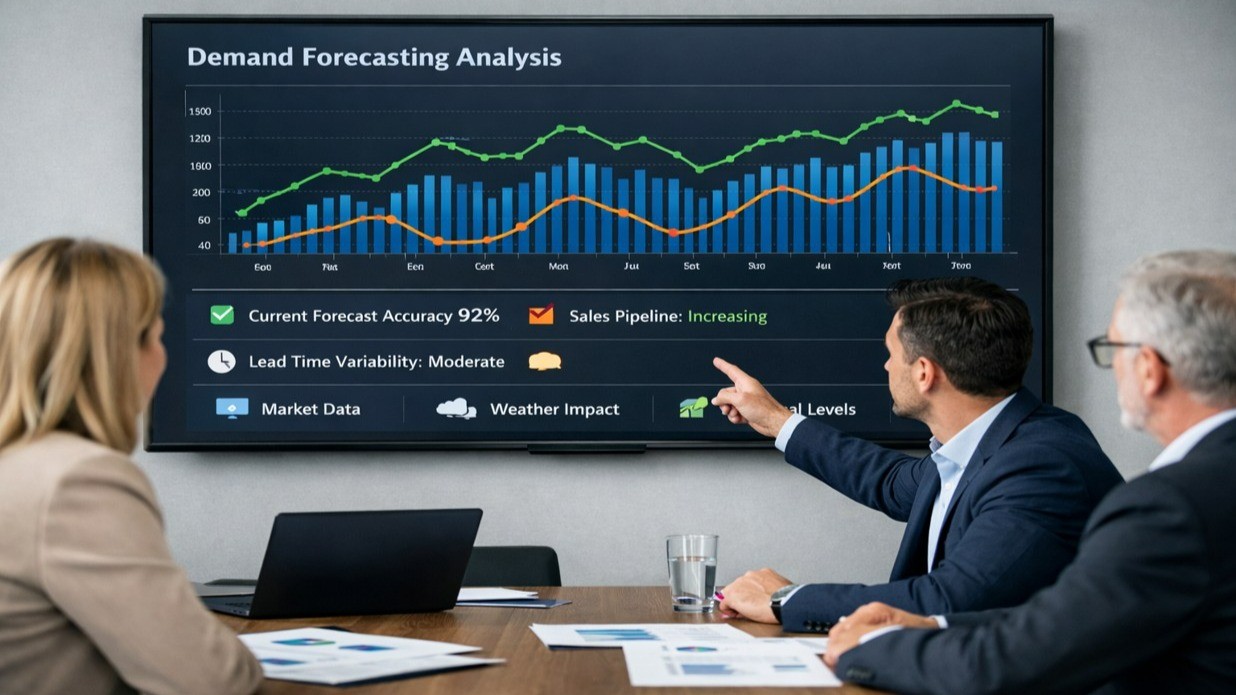
Artificial intelligence can improve forecasting by incorporating a wider set of signals: production schedules, sales pipeline indicators, maintenance plans, weather patterns (where relevant), project timelines, and lead time variability. It can also segment demand into stable and volatile components, allowing different replenishment strategies rather than one-size-fits-all planning. Importantly, it can quantify uncertainty: not only predicting expected demand but also estimating confidence intervals, which supports better safety stock decisions.
The procurement advantage is that forecasts become operationally usable. Teams can negotiate contracts earlier, allocate supplier capacity proactively, and reduce expedited freight and “spot-buy” premiums. Over time, better forecasting becomes a compounding benefit: fewer firefights, improved supplier relationships, and more predictable working capital.
4) Price forecasting and should-cost intelligence
Price volatility is one of procurement’s most visible challenges, particularly in categories tied to commodities, energy, logistics, and foreign exchange exposure. Many organisations track market prices but struggle to translate this information into sourcing decisions, contract structures, and timing.
Artificial intelligence can support price forecasting by correlating internal purchase history with external indices and operational drivers. It can model how price changes flow through different suppliers, regions, transport routes, and contract terms. Beyond forecasting, it can strengthen “should-cost” intelligence by decomposing a product or service cost into labour, materials, overheads, and logistics components—where inputs are available.
This enables a more professional negotiation posture. Procurement can distinguish between legitimate cost increases and unjustified margin expansion, and can choose contract mechanisms that match the risk profile: fixed price, indexed price, or hybrid structures. It also supports timing decisions: whether to lock in capacity now, stage volume releases, or diversify sources ahead of predicted inflation. The result is not merely savings; it is improved budget predictability and fewer surprises.
5) Smarter supplier selection using multi-factor scoring
Supplier selection has always been multi-factor: capability, quality, price, delivery performance, compliance, risk, and cultural fit. The challenge is that these factors are often assessed inconsistently. Scorecards may be completed manually, using subjective judgments, and based on limited evidence.
Artificial intelligence can improve supplier selection by integrating evidence from multiple datasets and standardising scoring logic. It can analyse historic delivery performance, defect rates, dispute frequency, responsiveness, contract adherence, and service outcomes, then propose a structured ranking. It can also incorporate risk indicators such as financial distress signals, adverse media, certification expiry, sanctions exposure, and geographic disruption risk.
Crucially, supplier selection should remain explainable. Procurement must be able to show why a supplier was selected and demonstrate fairness and auditability, particularly in regulated environments. The best implementations make the model’s drivers visible: what factors increased or reduced the supplier’s score, and what evidence supported those changes. This creates a defensible selection process that reduces bias, improves consistency, and strengthens stakeholder confidence.
6) Predicting supplier risk before it becomes disruption
Many organisations treat supplier risk as an annual assessment exercise rather than a continuous discipline. The result is predictable: risks are identified late, mitigation plans are rushed, and disruption costs rise.
Artificial intelligence enables near-real-time risk sensing. It can monitor a stream of internal and external signals: late deliveries, quality drift, changes in lead times, contract non-compliance, social media escalation, legal filings, and industry news. It can detect weak signals that individually seem insignificant but collectively indicate deterioration. For example, slight increases in invoice disputes, delayed responses to service tickets, and a rising defect trend may predict an impending reliability problem.
Procurement can then act earlier: audit the supplier, implement tighter inspection, shift volumes, build buffer stock, or qualify alternatives. Even where the organisation chooses to retain the supplier, early awareness reduces the impact of disruption. The strategic benefit is resilience: fewer operational surprises and a more stable service delivery environment for the wider business.
7) Contract intelligence and obligations management
Contracts are a primary control mechanism in procurement, but most organisations underutilise them. Key obligations, renewal dates, volume commitments, service levels, and penalty clauses are frequently buried in documents and are not actively monitored. This creates leakage: missed rebates, uncontrolled renewals, non-compliant spend, and weak enforcement of service terms.
Artificial intelligence can extract key fields from contracts, classify clauses, and map obligations to operational triggers. It can alert procurement when a supplier repeatedly breaches a service level, when a renewal date is approaching, or when spend is drifting outside contracted limits. It can also identify non-standard clauses that increase risk, such as unfavourable indemnities, weak termination rights, or ambiguous service definitions.
The value is twofold. First, it protects the organisation commercially by reducing leakage and enforcing contract discipline. Second, it improves procurement’s credibility: decisions are grounded in documented commitments rather than institutional memory. Over time, contract intelligence becomes a powerful governance layer that complements sourcing and supplier management.
8) Guided buying and reducing “maverick” spend
“Maverick” spend persists because purchasing is often difficult. If approved suppliers are hard to find, catalogues are outdated, or approval workflows are slow, teams will bypass procurement to keep work moving. This undermines negotiated value and increases risk.
Artificial intelligence can support guided buying by making compliant purchasing the easiest path. It can recommend the correct items and services based on user role, location, budget, and past purchasing patterns. It can automatically suggest preferred suppliers, flag non-compliant selections, and route approvals to the right people based on policy rules. It can also identify when users are repeatedly buying outside contract and provide targeted interventions rather than generic policing.
The benefit is behavioural: compliance improves because friction reduces. Procurement’s influence expands without increasing headcount, and savings improve because contract coverage is actually utilised. Additionally, guided buying can improve user experience—an often overlooked driver of procurement performance.
9) Better decision-making through scenario planning
Procurement decisions rarely have a single “right answer”. They involve trade-offs: cost versus risk, single-supplier efficiency versus multi-supplier resilience, speed versus control, and local flexibility versus standardisation. Scenario planning helps leaders choose intentionally, but traditional scenario work is time-consuming and limited in scope.
Artificial intelligence can accelerate scenario planning by modelling outcomes across multiple variables: lead times, exchange rates, input costs, service levels, supplier capacity constraints, and demand uncertainty. It can generate scenarios such as: “What happens if Supplier A fails?”, “What is the cost impact of diversifying to a second region?”, or “How should volumes be allocated to meet service targets at minimum risk-adjusted cost?”
This does not replace leadership judgement; it makes judgement better informed. When procurement can quantify trade-offs and present options clearly, it shifts conversations from opinion-driven debate to evidence-driven choice. That improves alignment with finance, operations, and risk stakeholders and leads to decisions that are more robust under uncertainty.
10) Detecting fraud, leakage, and control weaknesses
Procurement fraud and leakage often hide in plain sight: duplicate suppliers, suspicious bank detail changes, invoice splitting to avoid approval thresholds, and unusual price variances. Manual controls catch some issues, but they typically operate after the fact.
Artificial intelligence can identify anomalies earlier by learning what “normal” looks like for spend, supplier behaviour, and approval patterns. It can flag invoices with unusual timing, repeated rounding, inconsistent unit pricing, or unexpected changes in supplier details. It can also detect collusion risk indicators such as repeated awards to a supplier despite poor performance, abnormal sole-source justification patterns, or bid behaviour that suggests a lack of competition.
Importantly, this must be implemented with strong governance to avoid false accusations. The most effective approach positions the system as a triage mechanism: it highlights exceptions for human review, increases the efficiency of audit and compliance teams, and strengthens preventative control design. The value is reduced financial loss, improved trust, and a more resilient procurement environment.
11) Enhancing supplier collaboration and performance management
Supplier performance management often becomes a monthly or quarterly reporting exercise with limited operational impact. Artificial intelligence can make performance management more dynamic and collaborative by providing timely insights that both parties can act on.
For example, it can predict late deliveries based on production and logistics signals, recommend corrective actions, and quantify the impact of different interventions. It can also identify root causes of defects by correlating quality incidents with production batches, routes, or packaging changes. When shared appropriately, this moves the relationship from blame to improvement.
This is particularly valuable in strategic supplier relationships where the goal is not constant switching but continuous performance uplift. Procurement gains influence by becoming a facilitator of operational outcomes, not merely a negotiator. Over time, this strengthens supplier ecosystems, reduces total cost of ownership, and improves continuity of service.
12) Workforce productivity and the rise of the “augmented buyer”
Procurement roles are changing. Buyers and category managers are expected to manage more categories, handle more stakeholders, and deliver more value with leaner teams. Artificial intelligence supports this by augmenting routine work: preparing market scans, drafting supplier communication, summarising meetings, suggesting negotiation levers, and surfacing relevant contract clauses quickly.
The practical outcome is time reclaimed. Skilled procurement professionals spend less time on administrative tasks and more time on strategy, supplier development, risk mitigation, and stakeholder alignment. It also raises consistency: decisions are guided by common evidence rather than individual memory or experience.
However, this requires capability development. Procurement teams must learn to interpret model outputs, validate recommendations, and ask better questions of the system. They also need governance to prevent over-reliance. The “augmented buyer” is most effective when artificial intelligence improves preparation and analysis, while humans maintain commercial judgement, relationship management, and accountability.
13) Governance, explainability, and ethical procurement decisioning
Procurement decisions carry reputational and legal exposure. If a supplier is excluded unfairly, if a selection decision cannot be explained, or if a model unintentionally embeds bias, the organisation’s risk increases. As artificial intelligence becomes more involved in selection and prioritisation, governance becomes essential.
At minimum, procurement needs clear policies on: what decisions can be automated, what decisions require human approval, what data sources are acceptable, and how model performance is monitored. Explainability must be built in: decision drivers should be visible, and the system should provide evidence trails. Where models incorporate external signals, procurement should validate reliability and ensure compliance with data privacy requirements.
Ethical procurement also includes responsible supplier engagement. Suppliers should understand how they are evaluated and what behaviours improve their outcomes. Transparent rules improve fairness, reduce disputes, and strengthen trust. When governance is sound, artificial intelligence strengthens procurement integrity rather than undermining it.
14) Implementation roadmap: from pilots to measurable value
Many organisations run artificial intelligence pilots in procurement and then stall. The common reasons are predictable: unclear ownership, inadequate data, limited stakeholder buy-in, and success measures that are not tied to operational outcomes.
A pragmatic roadmap typically follows five phases:
Phase one: Value prioritisation.
Select two to four high-impact use cases (for example demand forecasting, supplier risk sensing, and guided buying) with clear metrics
Phase two: Data readiness.
Select two to four high-impact use cases (for example demand forecasting, supplier risk sensing, and guided buying) with clear metrics
Phase three: Controlled deployment.
Implement in a defined scope (a business unit or category), with clear governance and human oversight.
Phase four: Operational integration.
Embed insights into workflows: approvals, sourcing events, supplier reviews, and planning cycles.
Phase five: Scale and continuous improvement.
Expand coverage, measure realised outcomes, and refine models and policies continuously
Procurement transformation succeeds when it is operational, not theoretical. The goal is measurable improvement: reduced emergency purchasing, fewer disruptions, better forecasting accuracy, improved contract compliance, and more defensible supplier selection.
Conclusion
Yet the differentiator is not the technology itself; it is disciplined execution. Organisations that succeed treat artificial intelligence as part of a governed procurement operating model. They invest in data integrity, define decision rules, build explainability, and align stakeholders around measurable outcomes. Those that do not may generate impressive dashboards without changing operational results.
For procurement leaders, the opportunity is significant: to move from a function measured mainly on savings to one recognised for enterprise resilience, commercial confidence, and strategic impact. With the right foundations and governance, artificial intelligence becomes a practical advantage—one that compounds over time.
For procurement leaders, the opportunity is significant: to move from a function measured mainly on savings to one recognised for enterprise resilience, commercial confidence, and strategic impact. With the right foundations and governance, artificial intelligence becomes a practical advantage—one that compounds over time.