
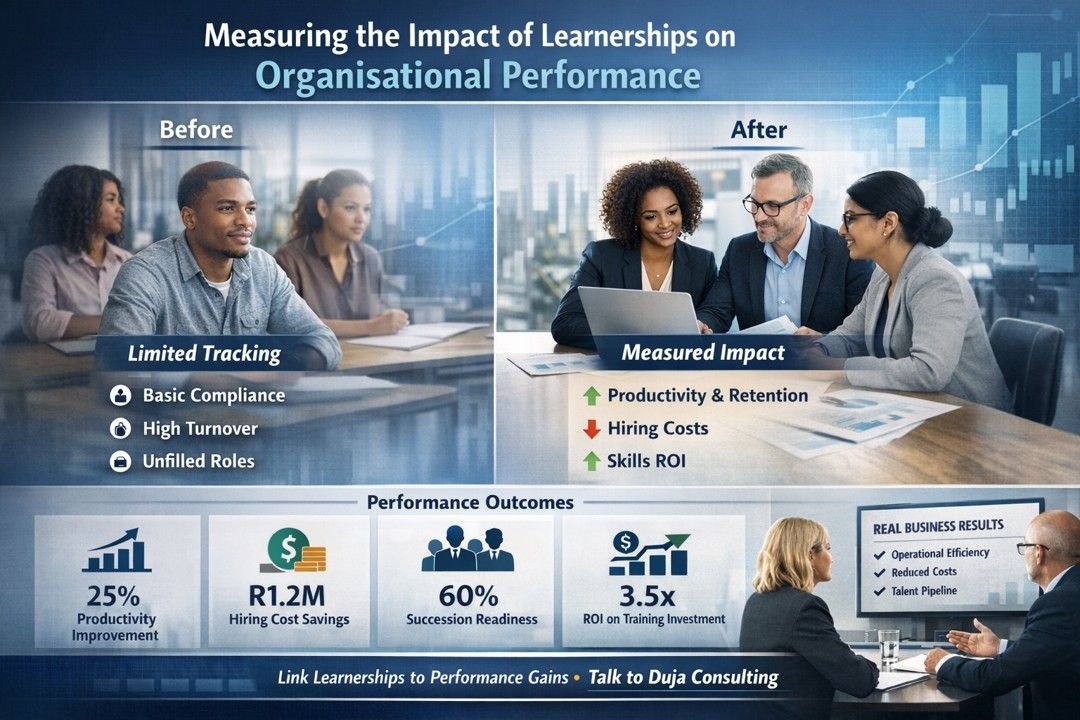
Measuring the Impact of Learnerships on Organisational Performance
Learnerships are often positioned as a compliance or social-impact initiative.
Yet when designed and measured properly, they become a powerful lever for operational performance, talent sustainability, and cost optimisation.
High-performing organisations move beyond counting learner numbers and completion rates.
They measure how learnerships contribute to:
- Improved workforce productivity and job readiness
- Reduced recruitment and onboarding costs
- Stronger succession pipelines in critical roles
- Lower operational risk through better-skilled teams
- Tangible return on training and skills investment
Without clear performance metrics, learnerships risk becoming an administrative exercise rather than a strategic asset.
The organisations seeing real value are those that link learnership outcomes directly to business performance indicators across procurement, operations, and finance.
If your organisation wants learnerships to deliver measurable impact and not just good intentions, the measurement framework matters.
An outcome-driven approach for leaders who want measurable value, not just compliance
Executive summary
Learnerships can be one of the most practical ways to strengthen an organisation’s talent pipeline, reduce operational friction, and improve productivity—yet many programmes are still evaluated using metrics that do not reflect business performance. Counting enrolments, completion rates, and training hours may satisfy reporting requirements, but it does not tell leadership whether capability has improved, whether performance has shifted, or whether the organisation is seeing a return on its skills investment.
A performance-led learnership approach starts with clarity: which organisational outcomes must improve, which roles matter most, and which measures will prove progress. It then links learnership inputs (recruitment, training design, workplace exposure) to outputs (competence and behaviours), and from there to measurable outcomes (time-to-proficiency, error reduction, throughput gains, lower attrition, reduced recruitment cost, stronger compliance execution, and improved customer outcomes). This article outlines a practical measurement framework, the key indicators that matter, and how to embed measurement into programme design so that learnerships become a credible driver of organisational performance.
Introduction
Organisations invest in learnerships for good reasons: developing talent, meeting skills development objectives, and creating opportunities for young people to build employability. But the biggest missed opportunity is failing to measure learnerships as a business performance lever.
When measurement is weak, a learnership programme risks becoming an administrative activity—busy, expensive, and difficult to defend when budgets tighten. When measurement is strong, learnerships become a strategic capability-building engine: they develop scarce skills, reduce dependency on external hiring, improve operational resilience, and strengthen the organisation’s ability to execute consistently.
The core question leadership should ask is simple:
What changed in the business because we ran this learnership programme?
If the answer is unclear, the programme is vulnerable.
If the answer is evidence-based, learnerships can compete for funding alongside other performance initiatives—because they can prove impact.
1) Why traditional learnership metrics fall short
Most learnership reporting focuses on:
- Number of learners enrolled
- Attendance and training hours
- Completion rates
- Assessment results
- Administrative compliance milestones
These metrics are necessary but not sufficient. They describe programme activity, not organisational outcomes. A learnership cohort can achieve 95% completion and still fail to move the needle on productivity, service quality, or talent shortages.
Performance-led measurement requires a shift from activity metrics to business impact metrics, such as:
- Time-to-proficiency in target roles
- Output per labour hour or shift performance improvement
- Error rates, rework, wastage, and compliance deviations
- Retention at 6, 12, and 24 months post-placement
- Reduction in recruitment spend and vacancy days
- Increased internal promotion rates and succession readiness
The goal is not to replace compliance metrics, but to connect them to performance outcomes.
2) A practical measurement logic: Inputs → Outputs → Outcomes → Value
A robust learnership measurement approach uses a simple logic chain:
Inputs
Budget, trainers, mentors, training materials, placements, time, systems support.
Outputs
Learners complete modules, achieve competence benchmarks, demonstrate target behaviours.
Outcomes
Improved job performance in the workplace: fewer errors, faster task completion, greater reliability, higher throughput, better customer experience.
Value
Reduced cost, increased capacity, lower risk, stronger talent pipeline, better performance stability.
This chain helps leadership answer:
- Are we training the right skills?
- Are learners becoming competent in the roles we need?
- Is operational performance improving because of that competence?
- Is the value worth the investment?
3) Start with the organisational performance problem you are solving
The highest-impact learnership programmes are designed around a clear business need. Examples include:
- High turnover in entry-level roles
- Skills gaps slowing down operations or service delivery
- Costly recruitment cycles and extended vacancy periods
- Poor quality outcomes due to inadequate capability
- Safety, compliance, and process deviations
- Limited succession pipeline for operational leadership roles
Measurement must be tied to the specific performance problem. If the performance objective is unclear, measurement becomes generic—and therefore unconvincing.
A simple way to define focus is to ask:
Which 3 organisational metrics must improve within 12 months for this programme to be considered successful?
4) Define success at three levels: learner, manager, and organisation
To measure impact properly, define success across three stakeholder lenses.
Learner success
- Competence progression milestones achieved
- Workplace readiness and confidence
- Attendance, punctuality, and professionalism metrics
- Behavioural indicators: communication, reliability, problem-solving
- Job placement and retention outcomes
Manager success
- Reduced supervision burden over time
- Improved team output consistency
- Improved adherence to process and quality standards
- Improved shift performance or service levels
- Stronger bench strength for promotions
Organisational success
- Lower recruitment and onboarding cost
- Shorter time-to-fill vacancies
- Increased productivity and throughput
- Reduced error rates, rework, and wastage
- Improved operational risk profile and compliance performance
- Stronger pipeline for critical roles
This three-level approach prevents measurement from being too “training-centric” and ensures business relevance.
5) Establish baseline measurements before the programme starts
One of the most common measurement failures is not capturing a baseline.
Without a baseline, improvements are subjective.
Baseline should include:
- Current productivity levels in the target roles (output per hour/day/shift)
- Current error, defect, rework, or wastage rates
- Current vacancy days and time-to-fill for relevant roles
- Current recruitment and onboarding costs
- Current turnover rates in target positions
- Current performance rating distribution in the relevant job families
Baseline data makes impact measurable and defensible. It also allows you to test whether improvement is due to the learnership, or due to other business changes.
6) Select the right Key Performance Indicators
Not every organisation needs complex metrics.
The key is choosing indicators that are both measurable and meaningful. Below are high-value options.
Productivity and operational performance indicators
- Output per labour hour / shift
- Cycle time reduction
- Service-level improvements (where applicable)
- Reduced backlog or improved throughput
- Reduced downtime linked to human error
Quality indicators
- Defect rates or error rates
- Rework frequency
- Customer complaints attributable to process failure
- Compliance audit outcomes (process adherence)
Talent pipeline indicators
- Time-to-proficiency: how long it takes a learner to perform independently
- Internal promotion rates from the learnership pipeline
- Succession readiness for supervisors/team leaders
- Reduction in critical role vacancies
Financial indicators
- Recruitment cost reduction (agency fees, advertising, screening time)
- Lower onboarding costs due to better preparedness
- Reduced overtime caused by staffing shortages
- Reduced waste and rework costs
- Improved retention reduces replacement cost
Risk and compliance indicators
- Reduction in safety incidents or near misses
- Improved compliance in regulated processes
- Reduced policy deviations and remedial actions
- Improved audit readiness due to stronger operational discipline
7) Track “time-to-proficiency” as the headline metric
If you need one metric that executives understand immediately, it is time-to-proficiency.
Time-to-proficiency measures how quickly a learner becomes independently productive in a role—without constant supervision or corrective intervention.
It can be tracked using:
- Workplace observation checklists
- Competency assessments at defined intervals
- Manager sign-off milestones
- Performance data comparisons against role benchmarks
Reducing time-to-proficiency improves capacity, reduces management burden, and accelerates the return on investment.
8) Build measurement into programme design, not after the fact
Impact measurement cannot be bolted on at the end.
It must be designed into:
- Learner selection criteria (ensure alignment to role requirements)
- Learning outcomes (mapped to job task performance)
- Workplace exposure (structured rotations tied to key skills)
- Mentoring (measured participation and progress)
- Assessment strategy (competence evidence, not just theory)
A strong model uses monthly performance checkpoints:
- Competence achieved vs planned
- Workplace performance indicators (quality, speed, independence)
- Manager feedback and learner self-assessment
- Corrective actions and coaching requirements
This creates an early-warning system and prevents “surprise failure” at the end of the programme.
9) Measure retention and progression after placement
A learnership is not complete when training ends.
The true performance impact often shows up after placement.
Track:
- Placement rate into relevant roles
- Retention at 6 months and 12 months
- Performance rating progression
- Attendance and conduct trends post-placement
- Promotion readiness at 18–24 months
- Comparative retention vs externally hired employees
This is where organisations often see significant financial value: retaining competent employees is cheaper than replacing them.
10) Quantify return on investment in plain business terms
To secure leadership buy-in, translate learnership outcomes into value.
A practical return on investment model includes:
- Cost of programme: training, administration, mentoring time, tools
- Value drivers:
- Reduced recruitment spend
- Reduced vacancy days (lost productivity)
- Reduced errors and rework
- Increased throughput or service improvement
- Reduced overtime due to staffing stability
- Reduced turnover replacement cost
You do not need perfect precision. Leadership typically responds well to credible ranges, such as:
- “We reduced recruitment costs by X–Y%”
- “We reduced time-to-proficiency by Z weeks”
- “We reduced error rates by A–B% in target tasks”
The key is transparency: show assumptions, show baseline, show trend.
11) Common pitfalls that destroy measurement credibility
Avoid these frequent errors:
- Measuring only training outputs, not workplace outcomes
- No baseline data captured
- Poor alignment between training content and job tasks
- Inconsistent manager participation in assessments
- Mentors not trained or not accountable
- Learners placed in roles that do not match the programme objectives
- Data scattered across systems with no consolidated reporting
If measurement feels “unreliable” or “too complex,” it will not be used—and leadership will default to gut feel.
12) The organisational enablers that make measurement work
Measuring impact reliably requires a few practical enablers:
- Clear ownership: a single accountable programme lead
- Standardised competency frameworks per target role
- Simple scorecards used consistently across sites/managers
- Regular governance cadence (monthly reviews, quarterly executive summary)
- Data discipline: one source of truth for KPIs and learner progress
- Manager and mentor enablement: training, templates, and expectations
The simpler and more repeatable the system, the more likely it will succeed.
Conclusion
Learnerships can be a measurable engine of organisational performance—but only when they are designed and managed like any other performance initiative. Measurement must connect learnership activity to workplace competence, and workplace competence to business outcomes.
If organisations want learnerships to earn a permanent place in strategic planning, they must prove what changed: faster proficiency, fewer errors, improved productivity, stronger retention, reduced recruitment spend, and better operational resilience.
The organisations that win will be those that treat learnerships not as a compliance obligation, but as a structured pipeline for performance and capability.