
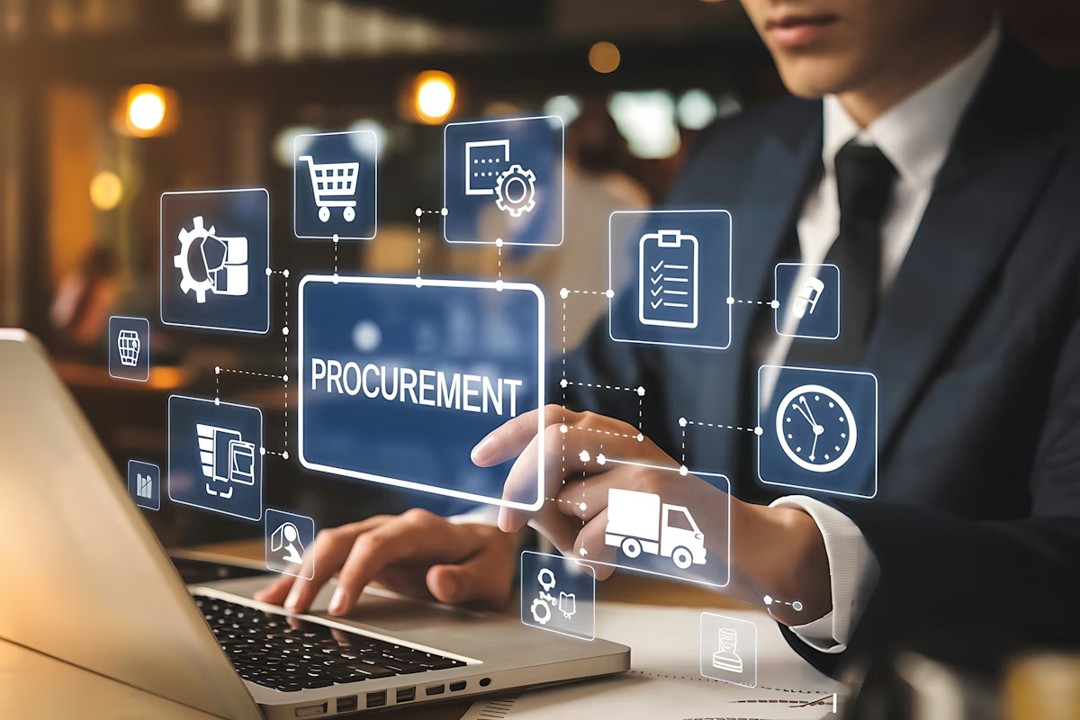
How AI Is Rewriting the Procurement Outsourcing Model — And What It Means for Your Business
AI is fundamentally changing procurement outsourcing — shifting value from labour arbitrage to intelligence arbitrage.
Discover how smarter data, outcome-based contracts, and AI-powered insights are reshaping what clients should expect from outsourcing partners.
How artificial intelligence is fundamentally transforming the procurement outsourcing model
For decades, procurement outsourcing followed a familiar script. A company handed off its purchasing operations to a third-party provider, locked in a multi-year contract, and hoped the savings materialised. The provider brought scale, category expertise, and offshore labour arbitrage. The client got cost reduction — and not much else. It worked well enough in a stable world. But the world stopped being stable, and the model started showing its age.
Supply chain disruptions, geopolitical volatility, inflationary pressure, and the accelerating pace of supplier market changes have all exposed the limitations of a model built primarily around cost efficiency. Procurement is no longer just an operational function — it is a strategic one. And outsourcing models that cannot keep up with that shift are increasingly being questioned by the very clients they were designed to serve.
AI is not simply upgrading the traditional model. It is rewriting the logic underneath it — shifting where value is created, who creates it, and what clients should actually be paying for. Understanding that shift is essential for any organisation currently evaluating, renegotiating, or building a procurement outsourcing relationship.
From Labour Arbitrage to Intelligence Arbitrage
The original value proposition of procurement outsourcing was straightforward: providers could do the same work more cheaply by deploying staff in lower-cost locations. That proposition still exists, but it is shrinking fast. Routine procurement tasks — purchase order processing, invoice matching, supplier onboarding, catalogue management, spend categorisation, compliance checks — are increasingly handled by AI systems that operate faster, more accurately, and at a fraction of the cost of even the most competitive offshore resource.
Natural language processing has made it possible to extract structured data from unstructured documents — contracts, invoices, emails — with a reliability that manual processing never achieved. Machine learning models can categorise spend, detect duplicate payments, and flag policy exceptions without human intervention. Robotic process automation, long a feature of procurement operations, is now being augmented by AI that can handle exceptions as well as standard cases, dramatically reducing the volume of work that requires a human touch.
This does not mean outsourcing is becoming less relevant. It means the basis of competition is changing. Providers who built their businesses on labour cost differentials are being forced to compete on something harder to replicate: the quality of their AI models, the richness of their data, and the depth of their domain expertise. The new arbitrage is intellectual, not geographic. And unlike geographic arbitrage — which any competitor can replicate by setting up an offshore centre — intellectual arbitrage compounds over time. Better models, trained on more data, get better faster. That creates a winner-takes-most dynamic that is reshaping the competitive landscape of the entire industry.
The Data Advantage Becomes the Real Moat
One of the most significant and underappreciated shifts is what AI does to data. Traditional outsourcing relationships generated plenty of it, but extracting insight required analysts, reports, and time. By the time a trend was identified, the opportunity to act on it had often passed. Market pricing windows closed. Supplier negotiations proceeded without the leverage that better intelligence would have provided. Risk signals went unnoticed until they became incidents.
AI changes the economics of insight fundamentally. Machine learning models trained on years of transaction data can identify pricing anomalies, flag supplier risk signals, predict demand fluctuations, and surface renegotiation opportunities in near real time. Benchmarking that once required weeks of analyst time can be refreshed continuously. Supplier financial health indicators can be monitored automatically, with alerts triggered when deterioration crosses a threshold. Category market intelligence, previously delivered in quarterly reports, can be updated dynamically as market conditions shift.
For outsourcing providers with large, diverse client portfolios, this is a structural advantage — they sit on datasets that individual companies simply cannot replicate. A provider managing procurement for fifty clients across a manufacturing vertical has seen more pricing cycles, more supplier failures, more contract structures, and more negotiation outcomes than any single client could accumulate in decades. The provider who can turn that aggregated experience into decision-ready intelligence, continuously and automatically, is offering something categorically different from what came before.
Clients are beginning to recognise this. The question they are starting to ask is not “how cheaply can you process my invoices?” but “what do you know about my spend that I do not know myself, and what are you doing about it?” That is a fundamentally different conversation — and it demands a fundamentally different kind of provider.
The Scope of Human Work Is Being Redefined
It would be a mistake to read this as a story purely about headcount reduction, though that is part of it. The more interesting and consequential shift is in what human expertise is now for. When AI handles the transactional layer reliably and at scale, procurement professionals — whether employed by the client or the provider — are freed to focus on the work that actually requires judgment: supplier relationship development, risk scenario planning, sustainability strategy, contract negotiation, innovation scouting, and cross-functional stakeholder alignment.
This is raising the bar for what good outsourcing looks like. Clients who previously measured provider performance by cost-per-transaction and SLA adherence are increasingly asking for business outcomes — total cost of ownership reduction, supply chain resilience scores, ESG compliance rates, working capital improvements. These are not metrics that can be gamed with cheap labour or volume incentives. They require strategic partnership and they require AI-enabled visibility into the supply base that most in-house procurement teams lack the technology or the data to achieve on their own.
There is also a talent dimension that deserves more attention than it typically receives. The best procurement professionals — those with genuine category expertise, strong supplier relationships, and commercial instinct — have always been in short supply. AI does not replace them; it amplifies them. A senior category manager supported by AI-driven market intelligence and automated analysis can cover ground that previously required a team. Outsourcing providers who attract and retain this calibre of talent, and who build AI tools that make them more effective, will be able to deliver quality of strategic engagement that was previously out of reach for all but the largest and most sophisticated clients.
Contracts Are Changing — Slowly, But Noticeably
The commercial structures of procurement outsourcing have historically been blunt instruments. Fixed-fee arrangements rewarded providers for doing less. Transaction-based pricing rewarded volume over value. Cost-plus models offered little incentive to innovate. Neither structure created strong alignment between what the provider was incentivised to do and what the client actually needed — which was continuous improvement in outcomes, not just stable delivery of process.
AI is beginning to enable something better, because it makes outcomes measurable in ways they previously were not. When you can track in near real time how much a renegotiation delivered against benchmark, or how much earlier a supplier risk signal was identified relative to industry average, or how working capital improved as a result of payment term optimisation, it becomes possible to build contracts around those outcomes rather than around inputs.
Gain-sharing arrangements, where the provider takes a percentage of demonstrable savings, are gaining traction. So are models that price on the basis of insight delivered rather than headcount deployed — where the contract value reflects the intelligence and decision support the provider contributes, not the number of people processing transactions in the background. Hybrid models that combine a base fee for operational delivery with a performance layer tied to outcomes are increasingly common in new contract negotiations.
These structures are still the exception rather than the rule. Many existing contracts remain anchored to legacy pricing models, and renegotiating them requires both parties to agree on measurement frameworks that did not exist when the original deal was signed. But the direction of travel is clear, and organisations entering new outsourcing relationships today should be pushing for commercial structures that put skin in the game on both sides.
The Integration Problem Is Not Going Away
None of this is frictionless. AI-powered procurement outsourcing depends on data quality and system integration, and both remain stubborn, persistent challenges. A provider’s AI is only as good as the data it can access, and many clients still operate procurement across fragmented ERP landscapes — multiple systems, inconsistent master data, limited API connectivity, and years of historical data trapped in formats that were never designed to be machine-readable.
Spend data, in particular, is notoriously difficult to work with. Inconsistent supplier naming conventions, miscategorised transactions, missing GL codes, and duplicate records are endemic in organisations that have grown through acquisition or that have never invested seriously in data governance. Before an AI model can generate reliable insight from that data, significant cleaning and normalisation work is required — work that is unglamorous, time-consuming, and easy to underestimate.
This creates a new kind of transition cost that did not exist in traditional outsourcing relationships — one that requires investment in data infrastructure, change management, and technical architecture before the AI dividend can be collected. Providers who help clients navigate this transition well, rather than treating it as a prerequisite the client must solve independently, will build the kind of deeply embedded relationships that are difficult to unwind. Conversely, clients who go into AI-enabled outsourcing expecting immediate results without addressing their data foundations are likely to be disappointed.
What This Means for Buyers of Outsourcing Services
If you are evaluating a procurement outsourcing arrangement today, the questions worth asking have changed substantially. It is not enough to assess the provider’s process maturity, their geographic footprint, or the size of their delivery centre. You need to understand the quality and specificity of their AI capabilities — not the marketing narrative around AI, but the actual models in use, what they are trained on, how they are validated, and how they improve over time.
You need to understand how they plan to share the productivity gains that AI delivers. As automation reduces the cost of transactional delivery, does that saving flow back to the client, or does it become margin for the provider? This is a conversation that many clients are not yet having explicitly, and they should be.
You should also be thinking carefully about what you are building internally. Outsourcing procurement operations does not mean outsourcing procurement strategy, and the companies that will extract the most value from AI-enabled providers are those who retain enough in-house capability to challenge, direct, interrogate, and build on what the provider is delivering. A client with no internal procurement expertise is not a strategic partner — it is a passive consumer of a service it cannot evaluate or improve.
The Model That Emerges
The procurement outsourcing model that is taking shape looks less like the traditional managed service and more like a data and intelligence partnership. The transactional work is increasingly automated, handled by AI systems that get more capable with each passing year. The human expertise — on both sides of the relationship — is concentrated on strategy, supplier relationships, risk management, and the complex edge cases that AI cannot yet handle with confidence. The commercial model rewards outcomes rather than activity. And the data generated by the relationship becomes a shared asset that compounds in value over time, making the partnership more valuable the longer it runs.
This is a better model than what it is replacing. It aligns incentives more cleanly. It creates more tangible value for clients. It demands more from providers — more investment in technology, more depth of expertise, more transparency about what is being delivered and why. And it makes the quality of AI capability the central competitive differentiator in a market that, until recently, competed primarily on price and geography.
The transition will not happen overnight. Legacy contracts, incumbent relationships, and organisational inertia will slow the pace of change in some organisations. But the underlying logic of the old model has already been disrupted. The question for procurement leaders and their outsourcing partners is not whether this transformation will happen, but whether they will be the ones shaping it — or the ones catching up.




The script is being rewritten.
The companies and providers who are reading ahead will be the ones who shape what comes next.