
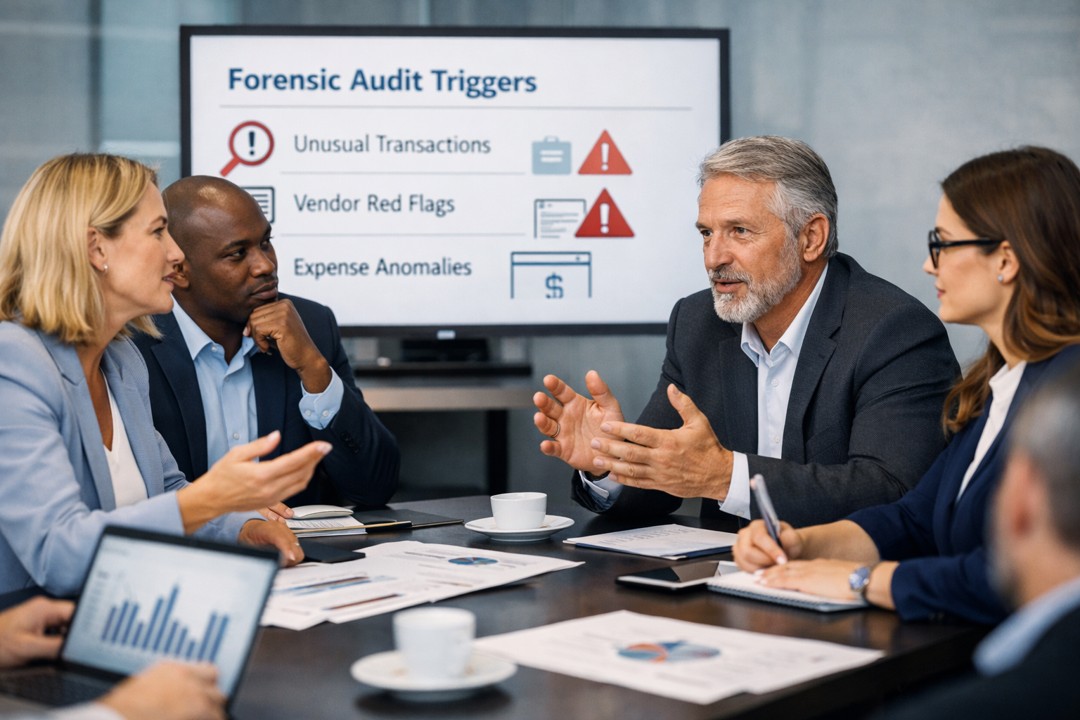
Training Internal Audit Teams to Recognise Forensic Triggers in Procurement
Most fraud is not uncovered by chance. It is detected because someone knew what to look for. Internal audit teams sit at the frontline of organisational risk, yet many are trained primarily for compliance and control testing, not for recognising early forensic warning signs.
Subtle anomalies in procurement patterns, vendor behaviour, payroll data, or expense claims are often dismissed as “operational noise” when they are, in fact, the first indicators of misconduct.
Training internal audit teams to recognise forensic triggers changes this dynamic. It sharpens professional scepticism, strengthens escalation decisions, and ensures potential issues are identified before they become material losses or reputational crises.
If you would like to discuss how procurement outsourcing can reduce risk exposure while improving control, transparency, and oversight, connect with Duja Consulting for a conversation.
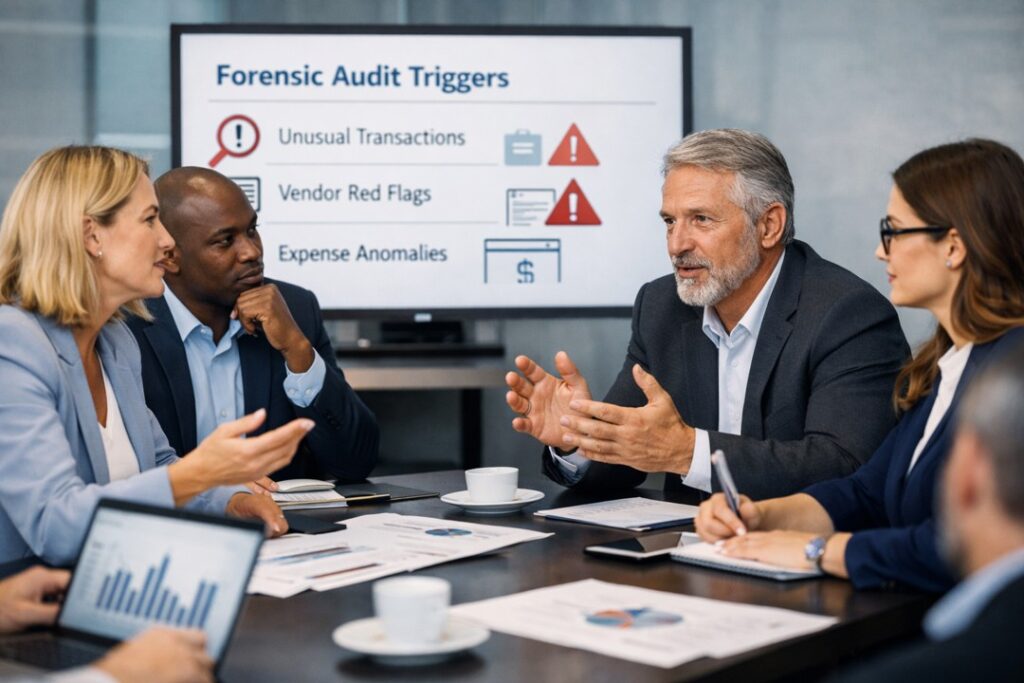
A practical capability playbook for earlier detection, stronger governance, and lower procurement risk
Most organisations invest heavily in controls, policies, and assurance plans — yet fraud and misconduct still slip through. The reason is rarely a complete absence of controls. It is more often a gap in recognition: early warning signs appear in routine audit work, but they are not identified as meaningful, or they are “explained away” as operational noise.
Internal audit is uniquely positioned to act as an early-warning system. Audit teams have access to processes, people, and data across the enterprise. They see exceptions, patterns, and workarounds before anyone else. But to convert that vantage point into earlier detection, internal audit teams need targeted training to recognise forensic triggers — the subtle indicators that suggest something may require deeper enquiry.
This article sets out what forensic triggers are, where they tend to hide (especially in procurement), and how to train internal audit teams to spot them early, document them correctly, and escalate with confidence.
What are forensic triggers?
Forensic triggers are observable indicators that a transaction, process, or behaviour may involve misrepresentation, collusion, conflict of interest, theft, bribery, or control override. A trigger is not proof.
It is a signal that:
- the risk profile has changed,
- the explanation does not match the evidence,
- the pattern is statistically unlikely, or
- the control environment is being bypassed.
The goal of training is not to turn internal auditors into investigators. It is to strengthen professional scepticism, improve the quality of red-flag recognition, and ensure potential issues are escalated early and cleanly — before they become material losses, legal exposure, or reputational damage.
Why internal audit often misses early signals
Even strong audit teams can overlook forensic triggers for predictable reasons:
- Checklist fatigue
Audit programmes can become overly procedural. Teams complete testing, record exceptions, and move on — without pausing to ask “What does this exception mean?” - Over-reliance on management explanations
When auditees provide plausible reasons, auditors may accept them without corroborating evidence, especially under time pressure. - Limited data interrogation
Many audits sample small sets of transactions. Fraud patterns often live in the “long tail” — the full population, split orders, repeated small values, unusual timings, or subtle vendor master changes. - Unclear escalation thresholds
Auditors sometimes see something “odd” but are uncertain whether it warrants escalation, how to document it, or how to avoid reputational harm if it proves benign. - Procurement complexity
Procurement is one of the most trigger-rich functions: many suppliers, many approvals, many exceptions — and frequent operational urgency that normalises workarounds.
Where forensic triggers show up most often
While triggers can occur anywhere, internal audit training should prioritise the highest-risk areas. Below are common categories and examples that auditors can be trained to recognise.
1) Procurement and supplier management triggers
Procurement is a prime environment for concealment because it combines discretion, urgency, and supplier dependence.
Common triggers include:
- Split purchasing to stay below approval thresholds.
- Repeat awards to the same supplier with weak justification, especially when alternatives exist.
- Unusual price variance for the same item across sites, business units, or time periods.
- Last-minute supplier onboarding immediately followed by purchase orders and rapid payment.
- Supplier master data changes (bank details, address, contact person) followed by payments.
- Round-number invoices, sequential invoices, or duplicate invoice values with minor description changes.
- High frequency of urgent, non-competitive procurement, particularly when consistently used by the same individuals.
- Concentration risk: a small number of suppliers capturing a disproportionate share of spend without strategic rationale.
- Unusual receiving patterns, such as goods received without proof of delivery, late proof, or repeated overrides.
2) Payroll and employee lifecycle triggers
Payroll irregularities often appear as “administrative errors” until they recur.
Common triggers include:
- Payments to employees with missing identity documentation or incomplete onboarding.
- Unusual overtime patterns (same individuals, same days, repeated exceptions).
- Ghost employee indicators, such as pay records without corresponding operational evidence.
- Allowance creep and repeated manual adjustments without supporting approvals.
3) Expense and travel triggers
Expense misconduct is often opportunistic and repetitive.
Common triggers include:
- Claims made just under thresholds, recurring across months.
- Duplicate receipts or similar receipts submitted by different individuals.
- Vendor patterns that suggest personal relationships (same small supplier repeatedly).
- Expense claims with weak supporting evidence or inconsistent narratives.
4) Revenue, refunds, and customer account triggers
Where refunds and credits exist, concealment can follow.
Common triggers include:
- Unusual spikes in refunds, credits, or write-offs in a specific period.
- Manual overrides in billing systems.
- High levels of “exception handling” by a small number of users.
5) Access, overrides, and system behaviour triggers
Control override is often the bridge between intent and execution.
Common triggers include:
- Users with incompatible access rights (for example, the ability to create and approve).
- Frequent approval overrides, backdated entries, or unusual timing (weekends, after hours).
- Generic accounts used for approvals or processing.
What “good” forensic trigger training looks like
A strong training programme blends mindset, method, and practical application. Consider a capability model with five core components.
1) A shared language of triggers
Create a common trigger framework across procurement, payroll, expenses, revenue, and systems. This reduces ambiguity and helps teams escalate consistently. A short, practical trigger library (two pages, not twenty) is often enough — provided it is used.
2) Professional scepticism as a skill
Professional scepticism is not cynicism. It is disciplined curiosity.
Training should focus on:
- how to challenge explanations respectfully,
- how to corroborate narratives with evidence,
- how to recognise rationalisations and normalised deviance.
3) Evidence-minded documentation
Internal audit workpapers are often written for assurance, not investigation.
Trigger training should improve the ability to document:
- what was observed (facts),
- why it is unusual (context),
- what evidence supports the concern (data),
- what alternative explanations exist (balance),
- what escalation is recommended (clarity).
4) Basic forensic data techniques
Auditors do not need advanced tools to improve detection materially.
Training should cover practical techniques such as:
- full population testing where feasible,
- trend analysis and outlier detection,
- vendor and employee duplication checks,
- threshold testing (just under limits),
- timing analysis (period-end, weekends),
- concentration analysis (supplier spend distribution).
5) Escalation pathways and governance
Training must clarify:
When do we escalate?
To whom?
How?
Good escalation pathways protect the auditor and the organisation by ensuring matters are handled proportionately and confidentially.
How to implement a forensic trigger programme in internal audit
A lightweight implementation approach typically works best.
- Baseline assessment
Review recent audits and identify where exceptions were logged but not explored. This often reveals immediate training opportunities. - Create a trigger library
Build a trigger set tailored to your risk profile — especially procurement categories, approval limits, supplier onboarding rules, and payment controls. - Run scenario-based workshops
Use realistic case scenarios: “Here is the data; here is the narrative; what do you do next?”
This builds judgement faster than slide-based training. - Embed triggers into audit programmes
Add trigger checks into planning, fieldwork, and closing stages. Make it part of “how we audit”. - Strengthen escalation hygiene
Introduce a standard “trigger escalation note” template so issues are raised consistently and responsibly. - Measure capability uplift
Use simple indicators: improved quality of exceptions, earlier identification of high-risk patterns, faster escalation, and cleaner handovers when investigation is required.
Why this matters most in procurement
Procurement is where financial value, third-party influence, and operational urgency collide.
It is also where misconduct can be masked as:
- urgency,
- supplier constraints,
- stock shortages,
- “business as usual” exceptions.
That is why training internal audit teams to recognise procurement-related forensic triggers is one of the highest-return governance investments an organisation can make. It improves not only detection, but also supplier governance, transparency, and commercial discipline.
Conclusion
Forensic triggers are rarely dramatic. They are usually quiet: a repeated exception, a vendor change, a pattern that does not make sense, or an explanation that fits too neatly. Internal audit teams see these signals every day — but without targeted training, the signals remain unconverted into action.
Training internal audit to recognise forensic triggers strengthens organisational defence, improves escalation quality, and reduces the likelihood of costly, disruptive investigations later. In procurement-heavy environments, it can be the difference between preventing a loss and explaining it.




If you would like to discuss how procurement outsourcing can improve control, transparency, and risk oversight, speak to Duja Consulting for a practical conversation.