
Why Leading Organisations Are Outsourcing Forensic Capabilities
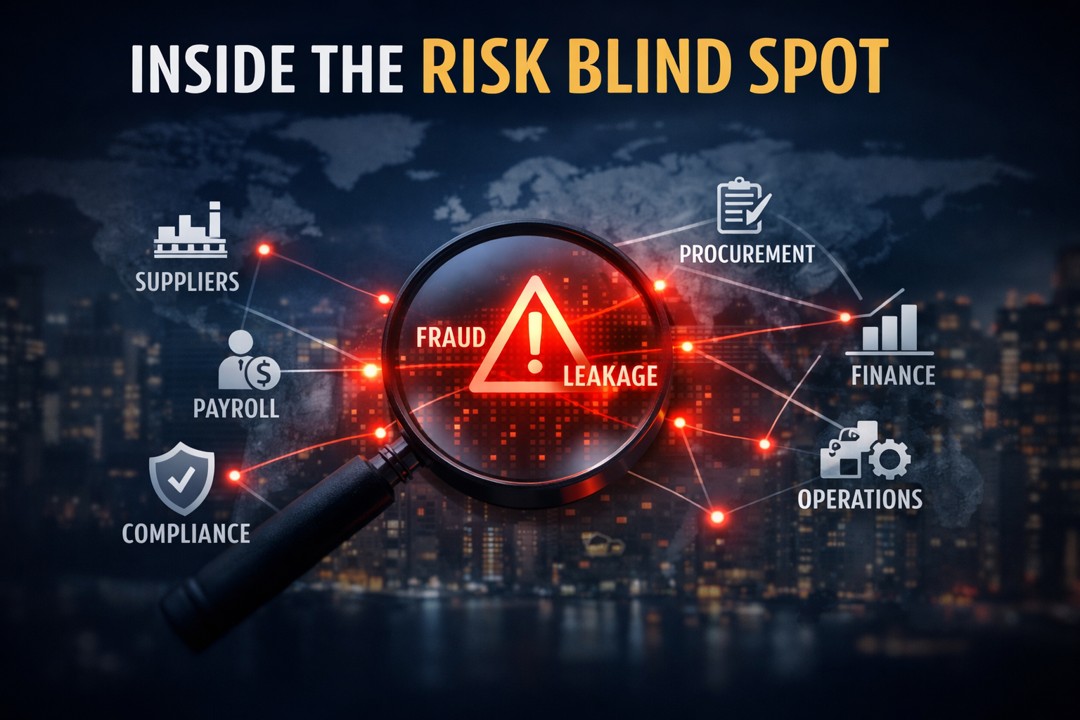
Forensic capability is no longer a “nice to have” reserved for crises. Leading organisations are recognising that fraud risk, procurement irregularities, payroll leakage, and control failures are now continuous, not episodic.
Increasingly, they are choosing to outsource forensic capabilities rather than build and maintain them internally.
Why?
- Specialist depth on demand – Access to seasoned forensic professionals without carrying permanent overhead
- Independence and objectivity – External teams remove bias and internal pressure from sensitive investigations
- Faster detection – Proven methodologies, analytics, and red-flag frameworks shorten time to insight
- Scalability – Capability flexes up during high-risk periods and down when exposure is lower
- Cost certainty – Predictable engagement models versus expensive, underutilised in-house teams
For many organisations, forensic outsourcing is no longer reactive. It is a strategic control, embedded alongside procurement, finance, and risk functions to prevent issues before they become reputational or regulatory events.
If procurement risk, supplier integrity, or internal controls are on your agenda, let’s talk about how Duja Consulting supports organisations through procurement outsourcing and forensic capability augmentation.
A Duja Consulting perspective for executives responsible for governance, procurement, finance, and risk
Executive summary
Forensic capability has shifted from a specialist “incident response” function to a continuous requirement for organisations that want to protect value, safeguard reputation, and sustain stakeholder confidence. The drivers are familiar: complex supply chains, high transaction volumes, decentralised operations, constant system change, and growing pressure for transparency. In this environment, organisations are increasingly choosing to outsource forensic capabilities rather than attempt to build and maintain full capability internally.
This is not a retreat from accountability. It is a strategic choice to access independence, depth, proven methods, and scalable capacity—while keeping internal leaders focused on running the business. Outsourced forensic capability can also be used proactively, strengthening controls before losses occur and identifying weaknesses in procurement and payment processes where leakage often hides in plain sight.
This article explains the reasons behind the trend, what “outsourced forensic capability” actually looks like in practice, where it delivers the most value, and how leaders can govern it properly to avoid common pitfalls. It closes with practical guidance on selecting a partner and integrating forensic capability into procurement operations and broader risk management.
The context: why forensic work is no longer occasional
Many organisations still treat forensics as something you call on when a serious allegation surfaces. But the operational reality has changed. Risk is no longer confined to a handful of “big events”; it often shows up as persistent leakage, patterned abuse, and slow erosion of control discipline.
This is especially true in procurement environments: multiple suppliers, large volumes of purchase orders, high frequency of invoices, complex pricing, contract variations, and decentralised approval chains. In such a setting, it does not take an organised fraud scheme to create meaningful loss. Small failures repeated at scale can produce significant exposure.
Leading organisations have recognised a simple truth: the cost of waiting is often higher than the cost of prevention. That is why the conversation has moved from “How do we investigate?” to “How do we detect early, prevent recurrence, and strengthen controls across the value chain?”
1) The specialist talent problem: depth is hard to build and harder to keep
Building internal forensic capability requires more than hiring a few skilled individuals. It requires a full ecosystem: experienced forensic leadership, data capability, case management discipline, strong reporting, legal awareness, and the credibility to handle sensitive matters at senior levels.
Even when organisations succeed in building this capability, they often struggle to retain it. Forensic professionals are in demand. Career pathways inside organisations may be unclear, and forensic teams can become isolated, under-resourced, or pulled into unrelated work. The result is capability that exists on paper but is inconsistent in practice.
Outsourcing solves for this by providing access to a stable bench of expertise that has already been trained, tested, and structured to deliver under pressure.
2) Independence is not a “nice to have”; it is foundational
Forensic work touches sensitive areas: executive decisions, procurement relationships, long-standing suppliers, internal networks, and uncomfortable truths about control failures. Internal teams can be exposed to real and perceived conflicts, whether through reporting lines, internal politics, or pressure to soften conclusions.
Leading organisations increasingly outsource forensics because they want:
- Objective findings that stand up to scrutiny
- Credibility with boards, audit committees, regulators, and external stakeholders
- Protection for internal leaders who need to act decisively without being accused of bias
Independence also improves outcomes. When people believe the process is fair and the facts will be handled professionally, cooperation increases and resistance decreases.
3) Scale and speed: the modern risk environment does not wait
Time matters. The longer an issue persists, the more costly it becomes—financially, operationally, and reputationally. Many internal teams simply cannot scale quickly enough during peak demand. A single serious matter can absorb attention, while multiple smaller issues continue undetected.
Outsourced capability provides surge capacity: more investigators, more analysts, and more experienced oversight when it matters most.
This helps organisations:
- Stop leakage faster
- Preserve evidence properly
- Reduce disruption to operations
- Prevent a single matter from consuming internal leadership bandwidth
4) Procurement and payment processes are high-exposure zones
If you want to understand why forensic outsourcing is growing, look closely at procurement and payment environments.
They combine high volume with high complexity. The risk surface is wide and often underestimated.
Common exposure points include:
- Supplier onboarding and due diligence gaps
- Conflicts of interest not declared or not managed
- Contract leakage through weak price controls and variations
- Non-compliant procurement routes that become “normalised”
- Split purchases and threshold manipulation
- Invoice and purchase order mismatches
- Duplicate payments, incorrect bank details, and manual overrides
- Weak segregation of duties in approvals and master data changes
What makes these risks difficult is that they rarely present as dramatic, obvious fraud. They often appear as “process exceptions” that accumulate over time.
A forensic approach—particularly one supported by analytics and control testing—can expose patterns quickly and recommend practical remediation.
5) The rise of data-driven forensics: capability is more than interviews and files
Modern forensic work is increasingly data-led. That means extracting and analysing transactional patterns, supplier behaviour, approval chains, and anomalies at scale.
Many organisations do not have the internal data capability to do this consistently. They might have analysts, but not forensic analysts. They might have systems, but not properly structured data. They might have dashboards, but not investigative logic.
Outsourced forensic teams bring repeatable analytical methods, tested indicators, and structured case workflows. They can also help the organisation build better detection routines over time—so issues are identified earlier, with less disruption.
6) Cost discipline: maintaining “always on” forensics internally is expensive
There is a practical financial reality behind the trend. A mature internal forensic unit requires sustained investment: salaries, tools, training, case management, and independent oversight. Yet demand is uneven. Some months are quiet; other months are intense.
Outsourcing turns a fixed cost into a flexible cost—capability can scale up or down. It also reduces the risk of underutilised specialist staff, while preserving access to expert capability when required.
This matters not only for budgets, but for leadership focus. Organisations want internal teams to concentrate on operations, transformation, and value creation—while ensuring risk is managed by specialists who do it every day.
7) Outsourcing supports prevention, not only response
A major misconception is that outsourcing forensics is only about investigations. Leading organisations use outsourced forensic capability in ways that strengthen the whole operating environment, such as:
- Control assessments in high-risk processes
- Targeted reviews of supplier categories or cost centres
- Procurement compliance reviews and exception analysis
- Payment process testing to identify leakage points
- Training internal teams to recognise forensic triggers
- Designing practical red-flag routines for early detection
This is where the return is often highest: preventing recurrence and closing the gaps that allow issues to spread.
8) Outsourcing enables stronger governance and clearer accountability
When organisations outsource forensic capability, they often become more disciplined about governance.
Why?
Because an external partner typically requires clear scope, defined decision rights, and structured reporting
This can improve internal clarity around:
- Who commissions forensic work
- Who receives findings
- How actions are tracked and monitored
- How confidentiality is maintained
- How remediation is embedded into procurement and finance processes
In well-governed environments, outsourced forensics strengthens accountability rather than diluting it.
9) What outsourced forensic capability looks like in practice
Outsourcing does not mean handing over responsibility. It means structuring a model where internal leaders retain ownership of outcomes, while specialists provide the capability.
Common operating models include:
- On-demand investigation support for specific matters
- Retained capability, where an external team is available within agreed timelines
- Embedded specialist support, working alongside procurement, finance, internal audit, or risk teams
- Proactive control and compliance monitoring, targeting high-risk processes
- Rapid response support for urgent matters requiring immediate containment
The right model depends on the organisation’s risk exposure, transaction volume, maturity of controls, and appetite for proactive monitoring.
10) The risks of outsourcing and how to manage them
Outsourcing forensic capability can fail if it is approached informally. Leading organisations manage the risks by setting clear expectations and governance.
Common pitfalls include:
- Unclear scope leading to delays or disputes
- Poor access to data and people, preventing fast progress
- Lack of executive sponsorship, causing remediation to stall
- Inadequate confidentiality controls, increasing reputational risk
- Over-reliance on the provider, without internal ownership of actions
These risks are addressed through structured engagement design: defined reporting lines, a clear escalation path, secure information handling, and visible leadership support.
11) How to choose a forensic outsourcing partner
Selecting a partner is not only about technical skill. It is about judgement, discipline, and the ability to operate in sensitive environments.
Practical selection criteria include:
- Demonstrated experience in procurement and payment environments
- A structured case methodology, with clear documentation and defensible findings
- Strong stakeholder management and the ability to brief senior leaders
- Data capability to identify patterns and prioritise high-risk areas
- A practical approach to remediation, not only diagnosis
- Clear confidentiality and information security practices
- A track record of independence and integrity
Conclusion: outsourcing is becoming a strategic control layer
Organisations that are serious about governance are moving away from an “investigate when something breaks” mindset. They are building continuous capability to detect issues earlier, respond faster, and strengthen controls—especially in procurement and payment environments where risk is concentrated.
Outsourcing forensic capability is not a sign of weakness. It is a mature recognition that specialist, independent, scalable capability can be embedded into the operating model—while internal leadership stays focused on execution and performance.
internal leadership stays focused on execution and performance.
The best outcomes happen when outsourced forensics is used not only for investigations, but for prevention: strengthening procurement governance, improving controls, tightening supplier oversight, and reducing leakage through better discipline and visibility.




If you are seeing signs of procurement leakage, supplier risk, recurring control exceptions, or concerns about the integrity of procurement and payment processes, we can help.
Duja Consulting supports organisations by strengthening governance, improving procurement discipline, and providing specialist capability where internal teams need independent support.
If you would like to explore procurement outsourcing and how it can reduce risk while improving control and performance, speak to Duja Consulting.