
Outsourced Forensic Response When Red Flags Appear
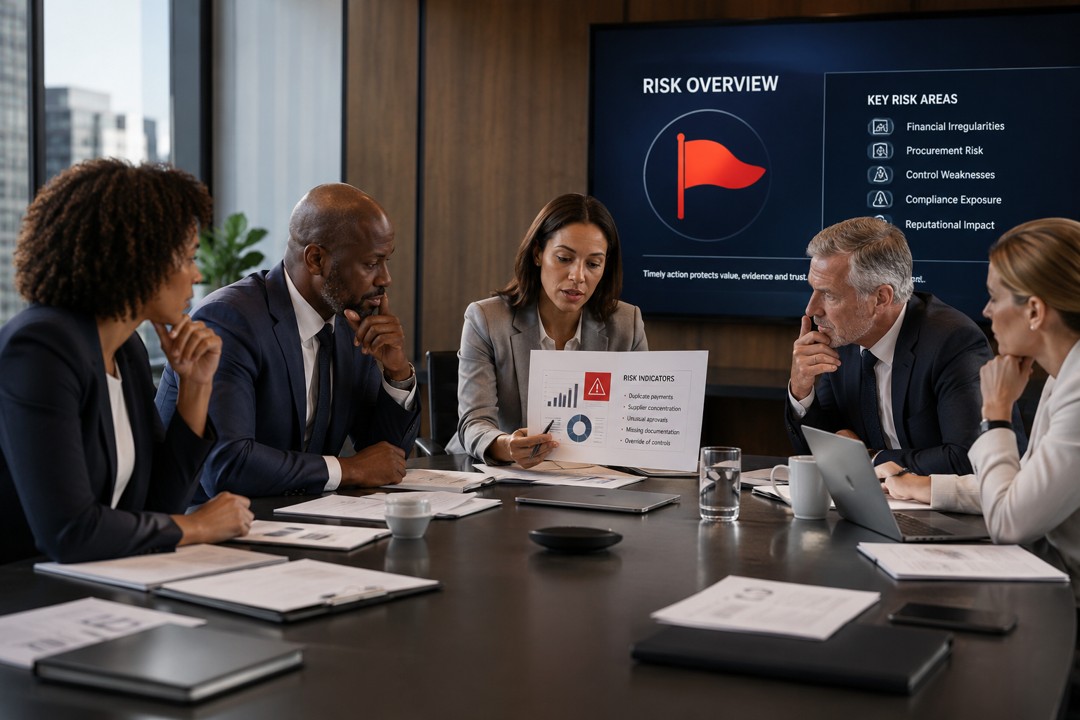
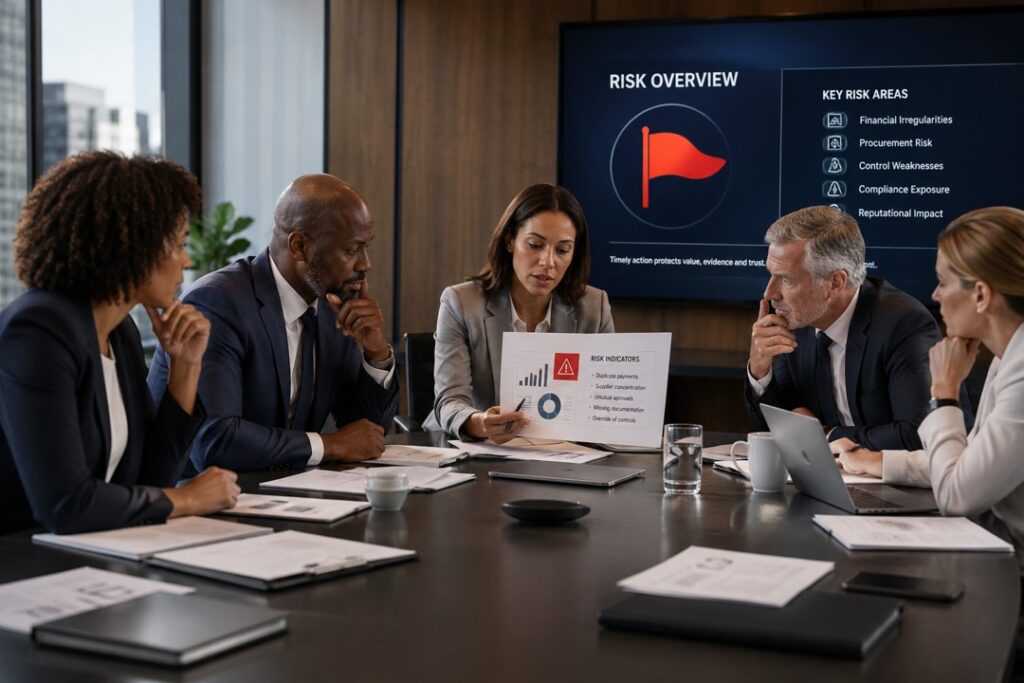
When a red flag appears, the first response matters. A suspicious supplier pattern. A whistle-blower report. Duplicate payments. Tender irregularities. Payroll anomalies. Missing documentation. These signs may not prove misconduct, but they should trigger a structured response.
In our latest article, Duja Consulting explores when organisations should activate an outsourced forensic response — and why speed, independence and evidence preservation are critical.
For boards, CFOs, audit committees, procurement leaders and risk teams, the key question is not only “what happened?” It is also “can we prove it, act on it and prevent it from happening again?”
When Red Flags Appear: Activating an Outsourced Forensic Response
Introduction
When suspicious transactions, supplier irregularities, whistle-blower reports or unexplained control failures appear, leadership has a narrow window to respond correctly. For South African organisations, activating forensic investigation services South Africa is not only about proving whether misconduct occurred. It is about preserving evidence, protecting the organisation, supporting good governance and giving decision-makers a defensible basis for action.
Fraud and economic crime rarely arrive with a clear label. The warning signs often begin as anomalies: a duplicate payment, a supplier with unexpected links to an employee, a tender process that feels unusually rushed, or a manager who consistently blocks scrutiny. The challenge is knowing when an internal review is no longer enough.
The Association of Certified Fraud Examiners’ 2024 Report to the Nations found that occupational fraud cases analysed in the study caused total losses of US$3.1 billion, with organisations estimated to lose 5% of revenue to fraud each year. It also found that a typical fraud case lasted about 12 months before detection, and that 84% of fraudsters displayed at least one behavioural red flag.
For boards, audit committees, CFOs, procurement leaders and risk teams, the message is clear: red flags should not be ignored, explained away or handled informally. They should trigger a structured forensic response.
What Counts as a Red Flag?
A red flag is any indicator that something may be wrong and that the organisation may need to investigate further. It is not proof of fraud, corruption or misconduct. However, it is a signal that the organisation should pause, assess and protect the integrity of the evidence.
Common forensic red flags include:
- Duplicate invoices, round-number payments or unusual payment timing
- Suppliers with unclear ownership, weak documentation or links to employees
- Tender processes with limited competition or unexplained scoring outcomes
- Override of procurement, payroll or finance controls
- Missing supporting documents or altered records
- Lifestyle changes inconsistent with known income
- Employees refusing leave, resisting handovers or blocking audits
- Whistle-blower complaints or anonymous tips
- Repeated emergency purchases from the same supplier
- Unusual journal entries, reconciliations or write-offs
Procurement fraud is especially relevant for organisations with complex supplier ecosystems. PwC’s 2024 Global Economic Crime Survey identified procurement fraud as one of the top three most disruptive economic crimes experienced by companies globally in the previous 24 months, behind cybercrime and corruption.
Why Speed Matters When Red Flags Appear
The first few days after a red flag appears are critical. If an organisation reacts too slowly, evidence may disappear, records may be altered, witnesses may be influenced and suspects may adapt their behaviour.
A forensic response should therefore begin with containment, not accusation. The priority is to understand the nature of the allegation, secure relevant information and ensure that the matter is handled independently and lawfully.
This is where outsourced forensic support can be valuable. An external forensic team brings independence, specialist investigative skills, digital evidence capability, interview discipline and reporting structure. It also helps avoid the perception that management is investigating itself.
PwC South Africa notes that corporate crime can pose a real threat to business sustainability and that moving assertively to prevent or counter illegal activity is critical.
When Internal Review Is No Longer Enough
Many issues can and should be handled through ordinary management processes. However, certain situations require escalation to an outsourced forensic response.
Leadership should consider external forensic support when:
1. The Allegation Involves Senior Employees
If the concern involves executives, finance leaders, procurement decision-makers or anyone with influence over evidence and witnesses, independence becomes essential. An outsourced forensic response reduces the risk of interference and strengthens the credibility of findings.
2. The Matter Involves Procurement, Tenders or Third Parties
Supplier-related misconduct can involve hidden ownership, collusion, inflated pricing, kickbacks or conflicts of interest. These matters often require data analysis, document review, supplier vetting and careful mapping of relationships.
PwC’s 2024 survey also found that 42% of respondents either did not have a third-party risk management programme or did not conduct risk scoring as part of that programme, highlighting a common weakness in third-party oversight.
3. There Is a Whistle-Blower Report
Whistle-blower allegations must be treated with care. South Africa’s Protected Disclosures Act provides procedures for employees in both the public and private sectors to disclose information about unlawful or irregular conduct and provides protection for employees who make protected disclosures.
An outsourced forensic response helps ensure that the allegation is assessed objectively, that confidentiality is protected and that retaliation risks are managed.
4. Evidence Is Digital, Distributed or Easily Deleted
Modern investigations often involve emails, accounting systems, procurement platforms, payroll data, access logs, device records and messaging platforms. If digital evidence is mishandled, the investigation may be compromised.
External forensic specialists can help preserve evidence, maintain a chain of custody and use data analytics to identify patterns that may not be visible through manual review.
5. The Matter May Require Reporting to Authorities
Some matters may create legal or regulatory reporting obligations. South Africa’s Prevention and Combating of Corrupt Activities Act 12 of 2004 includes provisions to strengthen measures against corruption and places a duty on certain persons in positions of authority to report certain corrupt transactions.
This is why organisations should involve legal counsel where appropriate and ensure that the forensic response is properly scoped from the outset.
What an Outsourced Forensic Response Should Do First
A credible outsourced forensic response should move quickly but carefully. The goal is not to rush to conclusions. The goal is to stabilise the situation and create a reliable foundation for decision-making.
The first phase should include:
1. Triage the Allegation
The team should clarify what is alleged, who may be involved, what systems or transactions are affected, and whether the matter is isolated or systemic.
2. Protect Evidence
Relevant documents, emails, system records, contracts, invoices, tender files and approval trails should be identified and secured. Access rights may need to be reviewed to prevent deletion or manipulation.
3. Define Scope and Governance
The investigation should have a clear mandate. This includes who appointed the forensic team, who receives updates, how confidentiality is managed and how legal privilege is handled where applicable.
4. Conduct Targeted Data Analysis
Data analytics can quickly identify duplicate payments, unusual vendor patterns, split purchases, approval overrides, pricing anomalies or relationships between employees and suppliers.
Kroll’s 2025 Financial Crime Report notes that more than 70% of surveyed executives expected financial crime risk to increase in 2025, with AI-powered cybercrime and AI use by cybercriminals among the reasons cited. This reinforces the need for technology-enabled investigation and monitoring capability.
5. Interview Witnesses Carefully
Interviews should be planned, sequenced and documented. Poorly handled interviews can contaminate evidence, alert suspects prematurely or expose the organisation to unnecessary employment-law risk.
6. Report Findings Clearly
The final output should provide evidence-based findings, not speculation. A strong forensic report should set out the allegation, scope, methodology, evidence reviewed, findings, control weaknesses and recommended remedial actions.
Why Outsourcing Can Strengthen Governance
Outsourcing a forensic response is not an admission that the organisation has failed. It is often a sign that leadership takes governance seriously.
An independent forensic partner helps:
- Demonstrate objectivity to the board, audit committee and stakeholders
- Reduce conflicts of interest
- Preserve evidence correctly
- Bring specialist investigation and data skills
- Support legal, disciplinary or recovery processes
- Identify control weaknesses beyond the immediate incident
- Provide clear recommendations for prevention
From Investigation to Remediation
The purpose of a forensic response is not only to identify what happened. It is to help the organisation prevent recurrence.
After the investigation, leadership should act on the control lessons. This may include strengthening procurement controls, improving supplier due diligence, revising approval limits, implementing conflict-of-interest declarations, enhancing whistle-blower channels, improving payroll controls or using continuous monitoring analytics.
A red flag should therefore be treated as both an incident and an opportunity: an incident requiring immediate response, and an opportunity to improve governance, accountability and resilience.
How Duja Consulting Can Help
Duja Consulting’s Audit & Forensic Practice supports organisations with independent forensic investigations, probity audits and fraud-related governance support. Our approach is practical, discreet and evidence-led, helping organisations respond to concerns in a structured and defensible way.
Whether the issue involves procurement, payroll, finance, third-party risk or internal control failures, Duja Consulting helps leaders move from suspicion to clarity.




Need to respond to a red flag?
Contact Duja Consulting to discuss an outsourced forensic response that protects evidence, supports good governance and gives leadership the confidence to act.