
The Capability Calendar for JSE-Listed Companies | Duja Consulting
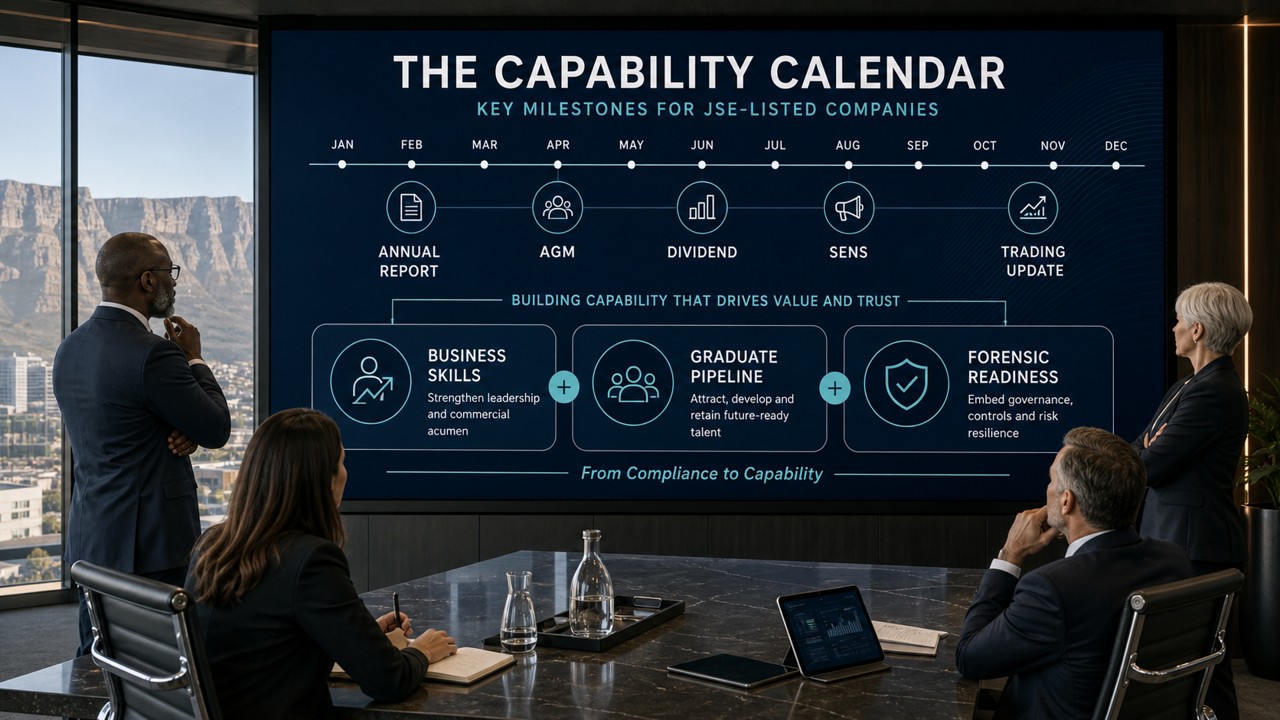
For many JSE-listed companies, this time of year is dominated by annual reports, AGM notices, dividend timetables, trading updates, board packs and SENS announcements.
But the listed company calendar is not only a compliance timetable.
It is a capability test. Every AGM, annual report and shareholder engagement asks a deeper question: can the organisation actually execute what it has promised?
That question depends on more than disclosure. It depends on people, controls and talent pipelines. Business skills courses help managers turn strategy into daily execution.
Graduate programmes build the next generation of capability.
Learnerships and internships give transformation plans practical substance.
Outsourced forensic auditing protects governance, accountability and trust. SDF, WSP and ATR processes create the evidence base behind skills development and transformation reporting.
For JSE-listed companies, the opportunity is to use this calendar moment to look behind the market-facing event and examine the operating reality that supports it.
At Duja Consulting, our view is simple. Listed company credibility is built not only through what a company publishes, but through the capability, conduct and control environment that sits behind it.
Why JSE-Listed Companies Should Treat AGM Season as a Workforce, Governance and Risk Readiness Test
For many JSE-listed companies, this time of year is dominated by visible market obligations: annual reports, AGM notices, dividend timetables, SENS announcements, trading updates, shareholder resolutions and board packs. A public market calendar for early May 2026 shows the familiar rhythm clearly: confirmed AGMs, dividend last-days-to-trade and dividend payment dates clustered across the week.
At first glance, these are capital markets events. They belong to the company secretary, the CFO, investor relations, the board and the external audit timetable. But that view is too narrow.
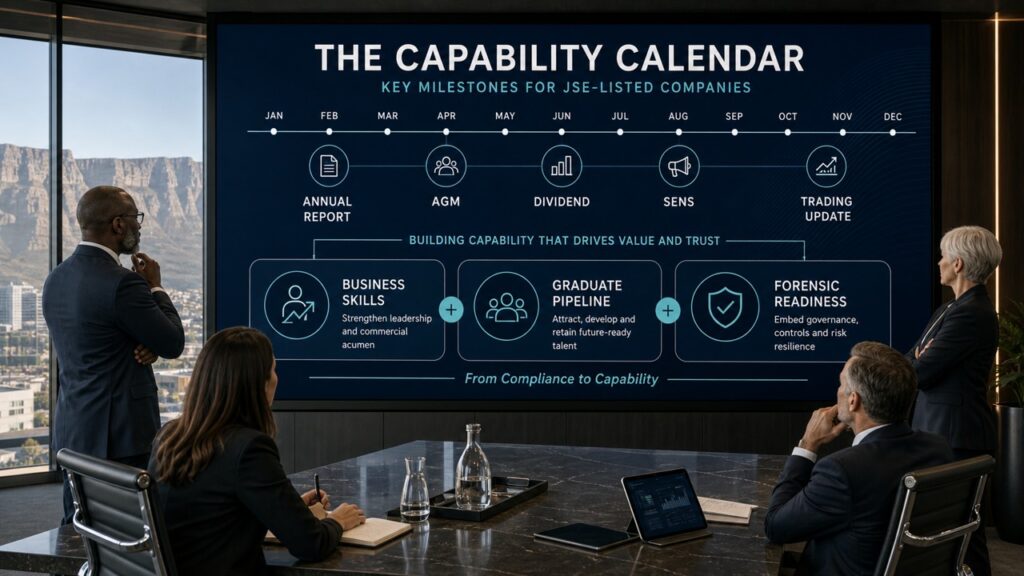
The listed-company calendar does not only test whether a company can disclose on time. It tests whether the organisation has the capability, conduct, talent and internal discipline to support what it is disclosing.
This is the moment when investors, regulators, employees and stakeholders are asking the same question in different ways: can this company execute what it has promised?
For executive teams, that question cannot be answered through compliance alone. It depends on three deeper forms of readiness: the readiness of people, the readiness of controls and the readiness of the next generation of talent.
That is where the calendar becomes more than a governance timetable. It becomes a capability calendar.
The market reads more than the numbers
JSE-listed companies operate in a disclosure environment where timing, transparency and confidence matter. Under continuing-obligation guidance for JSE issuers, annual reporting and AGM notice requirements are tied to the post-year-end timetable, with annual reports and AGM notices expected within the relevant period and ahead of the meeting. The JSE’s SENS channel is the formal market mechanism through which listed-company announcements such as mergers, takeovers, rights offers, capital issues and cautionaries are released to the market.
But investors do not read these items in isolation.
A dividend timetable says something about capital allocation. A trading update says something about operational visibility. An AGM vote says something about governance confidence. A remuneration report says something about alignment. A cautionary announcement says something about strategic optionality. A forensic matter, if mishandled, says something about the strength of internal controls and organisational culture.
The market is reading the sequence.
The executive challenge is that the sequence often exposes weaknesses long before they become formal crises. A company may have a polished strategy but underdeveloped middle-management capability. It may have a strong growth narrative but a fragile graduate pipeline. It may have good policies but weak practical training. It may have a robust code of conduct but insufficient forensic readiness when irregularities arise. It may have a transformation strategy but lack the operational machinery to implement learnerships, internships and graduate programmes at scale.
In other words, the calendar is not only asking whether the company is compliant. It is asking whether the company is capable.
Why capability now belongs on the board agenda
For listed companies, capability used to be treated largely as an HR concern. Training sat in a budget line. Graduate programmes sat in recruitment. Learnerships sat in transformation. Forensic auditing sat in risk, legal or internal audit. These functions were important, but often fragmented.
That fragmentation is now a strategic risk.
The modern board is expected to oversee performance, governance, conduct, transformation, succession, risk and stakeholder confidence as an integrated whole. The AGM has become a more substantive moment in that conversation. The Companies Act framework establishes the annual general meeting as a central governance event for public companies, and South Africa’s evolving governance environment has increased the importance of remuneration, social and ethics, and board accountability discussions.
At the same time, companies are operating with tighter margins, faster technology shifts, more demanding shareholders, complex regulatory expectations and a workforce that must adapt continuously.
The question for the C-suite is no longer simply:
What skills did we train this year?
It is:
What organisational capability do we need in order to deliver the strategy we have placed before the market?
That distinction matters.
Training is an activity.
Capability is a strategic asset.
The Duja Consulting perspective
Duja Consulting was established in 2005 and describes its work as providing professional talent solutions and business services, with a presence across Africa and the United Arab Emirates. Its stated purpose is “delivering sustainable impact”, and its work spans both transformational talent solutions and transactional business solutions.
That combination is particularly relevant to listed companies at this point in the calendar.
On one side, executive teams are preparing to explain strategy, governance and results. On the other, the organisation must build the skills, controls and talent systems required to make those explanations credible.
Duja’s offering sits at that intersection. Its talent solutions include learnerships, internships, graduate programmes, blended learning, assessment centre services and the Opti-Series of workshops for young professionals. Its business solutions include audit and forensic practice, procurement outsourcing, accounting and financial management outsourcing, and payroll, tax and administration services.
For JSE-listed companies, the relevance is clear: the same calendar that exposes disclosure obligations can be used to diagnose and strengthen the operating system behind the disclosure.
1. Business skills courses: from training spend to execution readiness
Duja Consulting was established in 2005 and describes its work as providing professional talent solutions and business services, with a presence across Africa and the United Arab Emirates. Its stated purpose is “delivering sustainable impact”, and its work spans both transformational talent solutions and transactional business solutions.
That combination is particularly relevant to listed companies at this point in the calendar.
On one side, executive teams are preparing to explain strategy, governance and results. On the other, the organisation must build the skills, controls and talent systems required to make those explanations credible.
Duja’s offering sits at that intersection. Its talent solutions include learnerships, internships, graduate programmes, blended learning, assessment centre services and the Opti-Series of workshops for young professionals. Its business solutions include audit and forensic practice, procurement outsourcing, accounting and financial management outsourcing, and payroll, tax and administration services.
For JSE-listed companies, the relevance is clear: the same calendar that exposes disclosure obligations can be used to diagnose and strengthen the operating system behind the disclosure.
1. Business skills courses: from training spend to execution readiness
Business skills training is often judged by attendance, completion rates and budget utilisation. Those measures have their place, but they do not answer the most important question: did the training change the organisation’s ability to execute?
This is especially important during the AGM and annual reporting cycle. Listed-company executives are making claims about strategic delivery, cost discipline, customer focus, transformation, digital change and operational resilience. Those claims depend heavily on the quality of supervisors, managers and young professionals across the organisation.
A board-approved strategy can fail in execution because team leaders cannot manage performance. A customer strategy can fail because frontline staff are not equipped to handle complex service expectations. A transformation plan can fail because recruitment managers do not understand bias, selection discipline and onboarding. A resilience strategy can fail because managers are overwhelmed, stressed and underprepared to lead through pressure.
These are not soft issues.
They are execution issues.
Duja’s Opti-Series is positioned as a set of workshops for young professionals covering customer service, recruitment, performance management and stress management. The series includes Opti-Select, focused on recruitment and selection practices in the South African context; Opti-Life, focused on stress management and managerial effectiveness; Opti-Serve, focused on customer satisfaction and loyalty; and Opti-Perform, focused on performance management.
For listed companies, that is not merely a training menu. It is a way to link business skills directly to the risks that executives are already discussing with boards and shareholders.
Consider four examples.
First, recruitment capability affects transformation, culture and succession. If recruitment managers cannot define roles properly, assess candidates consistently or mitigate bias, the company’s talent pipeline weakens. That weakness eventually appears in succession risk, diversity outcomes and leadership depth.
Second, performance management capability affects productivity and accountability. Many organisations have performance systems, but fewer have managers who can set clear objectives, give useful feedback, coach underperformance and use data constructively. Weak performance management becomes a hidden tax on execution.
Third, customer service capability affects revenue, reputation and retention. In a competitive environment, customer experience is not only a frontline matter. It is a strategic differentiator. The behaviour of teams shapes brand trust long before a marketing campaign does.
Fourth, stress management and leadership resilience affect decision quality. Executives understand the pressure at the top, but pressure is distributed throughout the organisation. Middle managers absorb operational shocks, employee concerns, customer dissatisfaction and delivery demands. If they lack practical tools for resilience, the organisation becomes slower, more reactive and more fragile.
The AGM season is a useful moment to ask whether training programmes are aligned to what the company is telling the market. If the annual report speaks about customer centricity, are customer-facing teams being developed accordingly? If the strategy emphasises operational excellence, are managers being trained to manage performance? If the company speaks about inclusive growth, are recruitment and selection practices being improved in practical ways? If leadership resilience is central to navigating volatility, are managers being equipped to lead under pressure?
The calendar should force the connection between boardroom language and workplace capability.
2. Graduate programmes: from transformation obligation to strategic talent pipeline
Graduate programmes, internships and learnerships are often discussed through the lens of B-BBEE, skills development and compliance. That lens is important, but it is incomplete.
Duja describes learnerships, internships and graduate programmes as strategic tools to create a young talent pipeline and support the B-BBEE scorecard. It also states that these programmes can support entry-level employment, supplier or client bases and tax benefits, and that work-based and work-integrated learning programmes play a prominent role in B-BBEE scorecard point allocation. SARS guidance on section 12H confirms that qualifying registered learnership agreements may give rise to additional annual and completion allowances where the statutory requirements are met.
For executives, the strategic issue is bigger than points.
South Africa’s listed companies face a dual talent challenge. They need experienced leadership now and future-ready talent for later. They need people who can work with data, technology, customers, controls and regulation. They need young professionals who understand not only theory, but workplace conduct, commercial discipline and organisational culture.
A graduate programme should therefore not be treated as an intake event. It should be treated as a leadership supply chain.
The weakness in many graduate initiatives is not intent. It is design. Graduates are recruited, placed and rotated, but the programme does not always have a sufficiently clear outcome. The organisation knows it wants young talent, but it has not defined what the young talent should be able to do after 12, 18 or 24 months. The result is often a programme that is busy, well intentioned and underpowered.
Duja’s approach speaks directly to that problem. It states that it supports clients across the full programme cycle: recruitment, assessment, matching, placement, programme design, training, relevant practical experience and post-completion placement. It also notes that its graduate solutions are designed to create a unique graduate journey, with individuals developed according to strengths and weaknesses in addition to technical training and experience.
That is the right level of ambition for listed companies.
The C-suite should be asking five questions about graduate programmes at this point in the corporate calendar.
First, is the programme linked to strategy?
If the company’s growth depends on digital transformation, data analytics, regional expansion, customer experience or operational excellence, the graduate programme should be designed around those priorities.
Second, is the programme linked to succession?
Graduate programmes should not sit outside workforce planning. They should feed into scarce skills, critical roles and future leadership pathways.
Third, is the programme measured beyond absorption?
Absorption matters, but it is not the only measure of success. Companies should also track readiness, retention, performance, mobility, diversity outcomes and manager feedback.
Fourth, is the programme properly managed?
Duja’s graduate and learnership implementation services include contracting, induction, work-readiness, technical and behavioural skills development, time and attendance, leave management, HR/IR services, payroll, coaching, mentoring and exit placement services. These operational details matter because poor administration can undermine even the best talent strategy.
Fifth, does the programme create ambassadors or alumni?
A well-run graduate programme does more than fill vacancies. It builds reputation. Graduates who experience clear development, meaningful work and consistent support become ambassadors for the organisation, whether they remain inside the company or move through the broader economy.
For JSE-listed companies, this is particularly important because the annual report and AGM increasingly tell a stakeholder story, not just a shareholder story. Employment, skills development, transformation and social impact are part of how the company explains its role in the economy. A credible graduate programme gives substance to that story.
3. SDF, WSP and ATR: the administrative backbone of skills strategy
One of the recurring lessons of listed-company life is that governance depends on evidence. Strategy without evidence becomes assertion. Transformation without evidence becomes aspiration. Skills development without evidence becomes anecdote.
That is why the skills development facilitator function matters.
Duja describes the SDF as responsible for the annual preparation, implementation and recording of training in an organisation, as well as liaison with the SETA on training initiatives, funding requirements and reimbursements. It also notes that the SDF works closely with the person responsible for the B-BBEE scorecard and provides data inputs into the scorecard process. Duja offers outsourced SDF services and consults on Workplace Skills Plans and Annual Training Reports, with strategic guidance for HR and Exco teams.
For listed companies, this is an important but often underappreciated control point.
The same discipline applied to financial reporting should increasingly be applied to skills reporting. Executives should know what training was planned, what was delivered, who benefited, what evidence exists, what funding or tax benefits may be relevant, and how the programme supports transformation and business needs.
A weak skills administration process creates multiple risks. It can weaken B-BBEE outcomes. It can cause missed funding or reimbursement opportunities. It can create uncertainty during verification. It can produce an annual report narrative that lacks substance. Most importantly, it can obscure whether the organisation is genuinely building the capabilities it needs.
The skills calendar should therefore be integrated into the listed-company governance calendar. WSP and ATR work should not happen in a silo. It should inform Exco discussion, board human capital oversight, transformation reporting and workforce planning.
This is where a provider such as Duja can help shift the conversation from compliance to strategic discipline. The objective is not simply to submit a plan. The objective is to build an auditable, evidence-based skills system that supports the company’s strategy.
4. Outsourced forensic auditing: the credibility safeguard
If skills development is about building capability, outsourced forensic auditing is about protecting credibility.
This matters deeply during the JSE calendar cycle. Annual reporting, AGM preparation and shareholder engagement all assume that the company has reasonable confidence in its controls, conduct and information. When fraud, misconduct, procurement irregularities, conflicts of interest, ghost employees or data anomalies emerge, the damage is rarely limited to the incident. It affects trust.
Duja’s Audit & Forensic Practice is positioned for forensic audit and investigative needs. The firm states that its Forensic Practice is a corporate member of the Association of Certified Fraud Examiners and has been operational since Duja’s inception in 2005. It describes its team as including forensic investigators, former police officials, chartered accountants, legal specialists, data analytics and digital forensic specialists.
That multidisciplinary model is important because modern corporate irregularities are rarely one-dimensional.
A procurement issue may involve policy breaches, conflicts of interest, supplier relationships, data trails and disciplinary consequences. A payroll issue may involve ghost employees, HR controls, banking details, approvals and internal collusion. A financial irregularity may involve accounting entries, bank statements, fictitious expenses, asset tracing and digital evidence. A regulatory compliance issue may involve contracts, internal policies, governance obligations and probity concerns.
Duja’s forensic areas of expertise include fraud risk management, forensic audit, human resources investigations, regulatory compliance and probity audits, digital forensic investigation and analysis, due diligence, litigation and dispute advisory, civil support, criminal support and disciplinary action support.
For JSE-listed companies, the strategic value of outsourced forensic auditing lies in three areas.
First, independence and objectivity.
When sensitive matters arise, internal teams may be too close to the issue, too capacity-constrained or too conflicted to investigate alone. An outsourced forensic partner can provide distance, method and credibility.
Second, specialist capability.
Forensic work requires skills that many organisations do not hold at scale internally: evidence handling, data analytics, digital forensic acquisition, legal process support, witness preparation, loss quantification and disciplinary documentation.
Third, speed and focus.
When the market is watching, delays compound reputational risk. A project-managed forensic process can help leadership move from suspicion to evidence, from evidence to decision, and from decision to remediation.
Duja notes that its forensic practice has been involved in planning and leading large-scale forensic and audit investigations, using a project management framework intended to ensure quality throughout investigations. That point is critical. Investigations do not only fail because of technical weakness. They fail because scope, evidence, communication, governance and timelines are poorly managed.
The board should therefore treat forensic readiness as part of annual governance readiness. Before the AGM, executives should know whether high-risk areas have been reviewed, whether whistle-blowing matters have been assessed, whether conflicts of interest are being managed, whether procurement and HR controls are functioning, and whether any unresolved matters could become market-sensitive.
The best time to build forensic readiness is before an issue becomes a SENS matter.
5. The integrated opportunity: skills, talent and controls as one agenda
It is tempting to treat business skills courses, graduate programmes and outsourced forensic auditing as separate services. In a listed-company context, they should be viewed as connected levers.
Business skills training improves the quality of everyday execution. Graduate programmes build the future talent pipeline. SDF, WSP and ATR support the evidence base for skills development and transformation. Forensic auditing strengthens accountability, control and trust.
Together, they support a central executive goal: making the organisation easier to believe.
That phrase matters. The market does not only reward companies that publish on time. It rewards companies that demonstrate coherence between what they say and how they operate.
A company that claims operational excellence should be able to show disciplined performance management. A company that claims customer centricity should be able to show practical customer service capability. A company that claims transformation should be able to show structured, well-managed graduate and learnership programmes. A company that claims strong governance should be able to show forensic readiness and control discipline. A company that claims resilience should be able to show leadership capability under pressure.
This is the deeper opportunity of the JSE calendar. It creates a natural moment for executive teams to review whether the organisation’s internal capability supports its external story.
A practical C-suite checklist for this season
As AGMs, annual reports, dividend timetables and shareholder engagements move through the calendar, executive teams should consider using this period to ask the following questions.
On business skills:
Are our managers equipped to deliver the strategy we have communicated to the market? Do they know how to manage performance, handle stress, recruit fairly, onboard effectively and serve customers consistently?
On graduate programmes:
Do our learnerships, internships and graduate programmes build a genuine talent pipeline, or are they mainly compliance activities? Are programme outcomes linked to scarce skills, future roles and business priorities?
On skills administration:
Are our WSP, ATR, SDF and B-BBEE skills-development processes accurate, timely and evidence-based? Can we confidently support the claims we make in governance, transformation and sustainability reporting?
On forensic readiness:
Do we have the capacity to respond quickly and credibly to suspected fraud, misconduct, procurement irregularities, HR issues, conflicts of interest or digital evidence requirements?
On board confidence:
Can the board see a clear link between the company’s strategy, its people development agenda and its control environment?
These questions are not merely operational.
They are investor-confidence questions.
From calendar compliance to capability confidence
The JSE calendar will always require disciplined compliance. Deadlines matter. SENS matters. Annual reports matter. AGM notices matter. Shareholder votes matter.
But the companies that stand out will be those that use the calendar for more than compliance. They will use it to strengthen the organisation behind the disclosure.
For Duja Consulting, that is the practical meaning of sustainable impact. It is not abstract. It is found in the design of a graduate journey. It is found in the quality of a manager’s performance conversation. It is found in a properly managed learnership. It is found in an accurate skills development record. It is found in a forensic investigation that protects evidence, accountability and trust.
The capability calendar asks listed-company leaders to look behind the market-facing event and examine the operating reality that supports it.
When the annual report speaks about people, are the programmes in place?
When the AGM speaks about governance, are the controls credible?
When the strategy speaks about growth, is the talent pipeline ready?
When the dividend speaks about confidence, is the organisation disciplined enough to sustain it?
When SENS speaks to the market, is leadership prepared for what follows?




This is the executive opportunity.
Treat business skills, graduate programmes and forensic readiness not as separate interventions, but as core components of listed-company credibility.
Because the calendar is not only a compliance timetable.
It is a test of capability.