
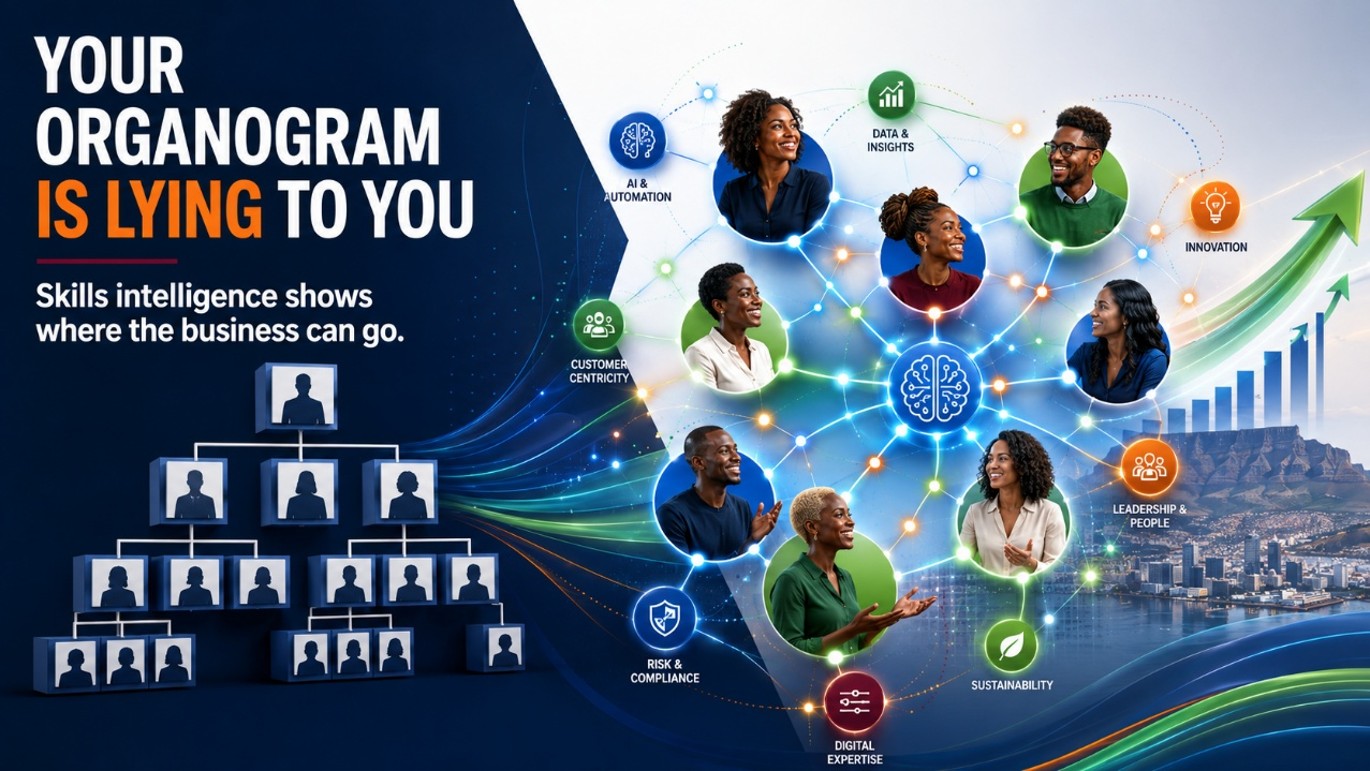
YOUR ORGANOGRAM IS LYING TO YOU
YOUR COMPETITIVE ADVANTAGE IS HIDDEN IN PLAIN SIGHT
Most organisations know where their people sit. Far fewer know what their people can actually do!
An organogram shows reporting lines I A job title describes a formal role I A qualification records what someone studied I A performance agreement defines what someone is expected to deliver.
None of these reveals the full depth of capability already sitting inside the business:
- The project manager who can interpret data.
- The administrator who understands customer behaviour.
- The finance specialist who can automate a manual process.
- The technical expert who can translate complexity into a compelling client solution.
- The graduate whose side hustle has developed real capability in digital marketing, sales, logistics and customer service.
- The experienced employee carrying years of institutional knowledge that has never been formally captured.
Their job titles tell you where they are. Their skills tell you where the business could go
EVERY BUSINESS HAS A HIDDEN SKILLS ECONOMY
Every organisation has two workforces.
- The first is visible: positions, grades, departments, qualifications and reporting structures.
- The second is largely invisible: technical expertise, human capability, lived experience, sector knowledge, relationships, problem-solving ability, digital competence, entrepreneurial instinct and untapped potential.
Competitive advantage increasingly sits in the second workforce. Yet many organisations continue to manage talent through the architecture of jobs rather than the intelligence of skills.
People are recruited into boxes, evaluated against boxes and promoted through boxes. Expertise that falls outside a job description frequently remains undiscovered, underutilised or eventually lost. A more powerful question is therefore required: What if the capability needed for your next growth opportunity is already inside the business—but hidden under the wrong job title?

The Skills Clock Is Already Running
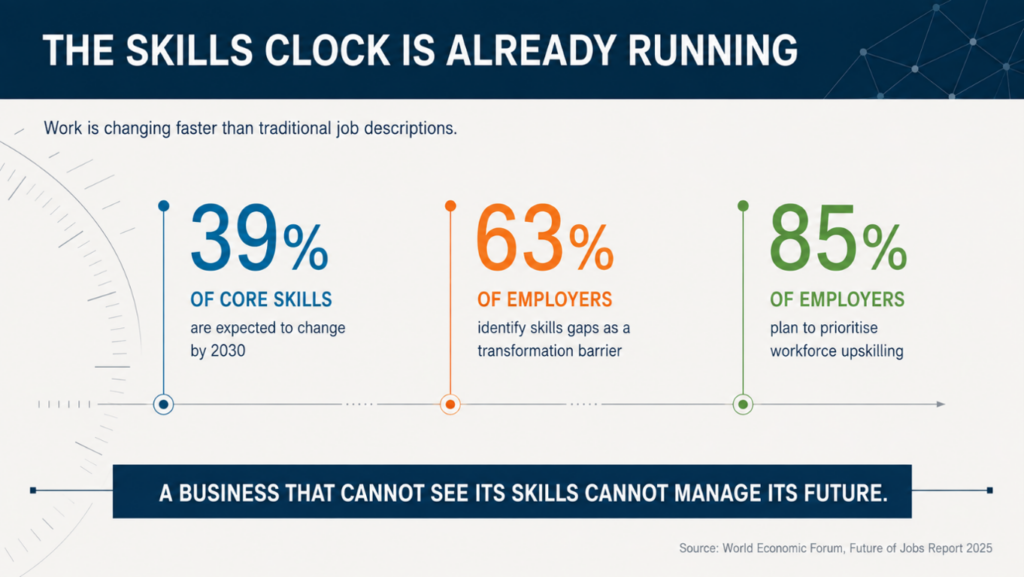
The World Economic Forum reports that:
- 39% of workers’ core skills are expected to change by 2030;
- 63% of employers identify skills gaps as a major barrier to business transformation; and
- 85% plan to prioritise workforce upskilling.
Technology skills in AI, big data and cybersecurity are growing rapidly, yet human capabilities such as analytical thinking, creativity, resilience, leadership and collaboration remain critical.
A Skills-Based Organisation Changes the Question
Traditional workforce planning asks: “How many people do we have in each position?”
A skills-based organisation asks: “What capabilities do we have, what capabilities will we need next, and how quickly can we mobilise them around business priorities?”
It is not an HR terminology change; it is a different operating model:
- Work begins to move to people according to capability, not only hierarchy.
- Recruitment focuses on demonstrable competence and potential, not merely qualifications and previous job titles.
- Learning investment targets real capability gaps.
- Internal mobility improves because employees become visible beyond their current positions.
- Workforce planning becomes connected to markets, technology, innovation, succession and future customer demand.
- The organisation stops managing static headcount and starts activating dynamic capability.
Removing unnecessary qualification requirements from job advertisements is useful—but it is only the front door. A genuine skills-based organisation applies skills intelligence across the entire workforce lifecycle
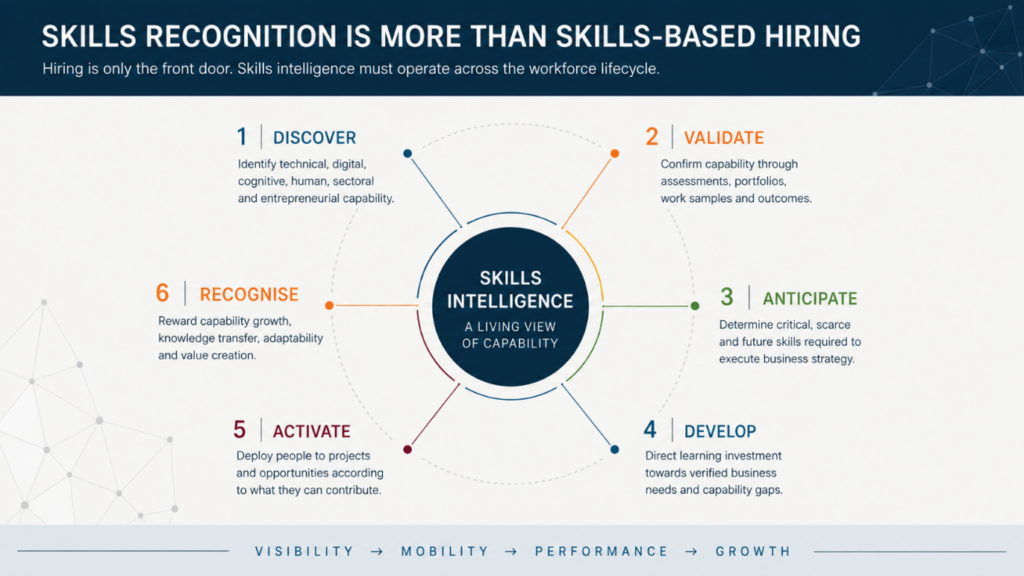
Recognition without activation creates a sophisticated skills database. Recognition followed by deployment creates business value.
Stop Treating Human Capability as Headcount -machines are resources, capital is a resource, technology is a resource.
People bring something fundamentally different: judgement, curiosity, imagination, relationships, contextual intelligence and the ability to create value in situations that have never existed before.
AI can accelerate analysis and automate tasks. Human expertise still determines:
- Which problems are worth solving?
- Which insights are credible?
- Which risks are acceptable?
- How technology should be applied
- How will customers and communities respond? and
- Which decisions will create sustainable value?
Future competitiveness will not come from choosing between human expertise and technology, it will come from combining them intelligently.
From Talent Ownership to Talent Flow
Traditional organisations allow departments to “own” people. Skills-based organisations allow capability to flow towards value.
- A data analyst can support a strategic bid.
- A learning specialist can contribute to product design.
- A customer-service employee can identify a process innovation.
- A young employee can help senior leaders understand an emerging digital market.
- A retiring expert can transfer scarce institutional knowledge through structured mentoring.
Recent Deloitte research Deloitte: Navigating the End of Jobs, found that organisations using skills-based practices are:
- 107% more likely to place talent effectively;
- 98% more likely to retain high performers; and
- 57% more likely to be agile.
The competitive benefit is therefore not simply better recruitment; it is faster access to the right capability at the moment the business needs it.
Imagine the Monday-Morning Conversation Changing
Instead of asking: “Who has capacity?”
Leadership asks: “Who has the right combination of skills, experience and potential to solve this?”

Instead of asking: “Which position must we create?”
The business asks: “Which capabilities must we assemble?”
Instead of asking: “What course should we send everyone on?”
The business asks: “Which capability gap is constraining performance, and what is the most effective way to close it?”
Better and informed questions produce better workforce decisions.
Turning Hidden Skills into Competitive Advantage
Recognising skills is the starting point, converting them into productivity, agility, innovation and growth requires deliberate strategic planning.
Duja Consulting Skills Development Advisory Services help organisations move beyond fragmented, compliance-driven training towards an integrated, future-focused approach to workforce capability.
Our expertise includes:
- Strategic workforce and skills planning;
- Organisational skills audits and capability mapping;
- Critical, scarce and future-skills analysis;
- Workplace Skills Plans and Annual Training Reports;
- Customised learning and career pathways;
- Learnership, internship, graduate and workplace-experience programmes;
- Digital, technical, human and leadership development;
- Innovative upskilling and reskilling solutions;
- Funding-aligned programme design and implementation; and
- Monitoring, evaluation and measurement of skills-development impact.
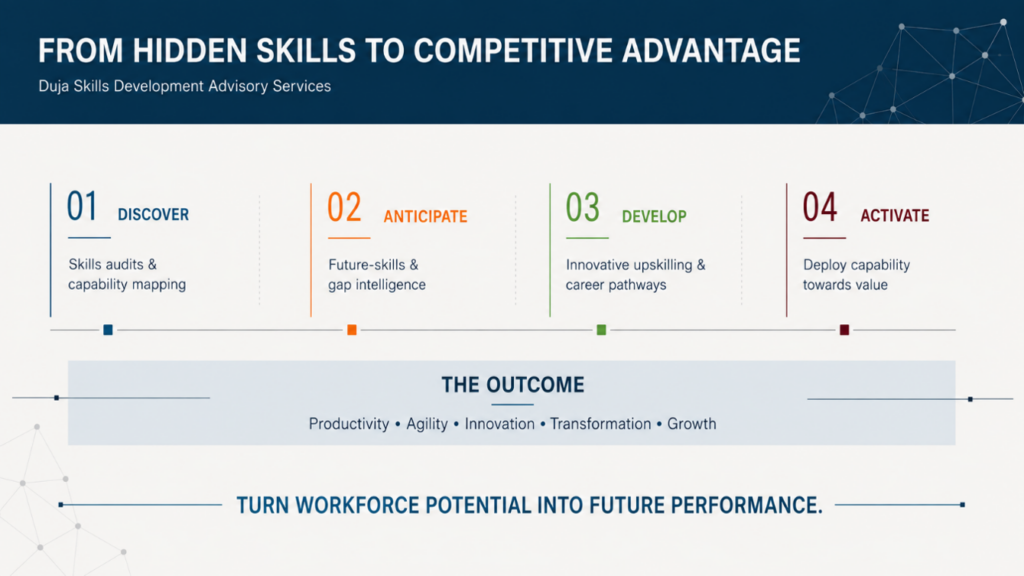
Duja’s approach starts with a strategic question:
What must the business be able to do next—and what combination of skills, expertise and learning will make that possible?
We help organisations:
DISCOVER
ANTICIPATE
DEVELOP
ACTIVATE
the capabilities they already possess.
the skills they will require in the future.
people through targeted and innovative learning pathways.
capability where it can create the greatest value.
South African organisations cannot afford training programmes that produce attendance registers and certificates without changing how people work or how the business performs.
Skills development should solve problems, strengthen performance, support transformation and build a sustainable pipeline of capability.
Duja’s skills-development approach connects workforce planning, succession, leadership development, innovative learning and measurable business outcomes.
The Future Will Belong to Organisations That See Their People Differently
Future-ready organisations will not compete through technology, capital or strategy alone. They will compete through their ability to:
- recognise expertise earlier;
- anticipate capability requirements more accurately;
- develop people faster;
- move skills across organisational boundaries; and
- deploy human capability more intelligently than their competitors.
The greatest untapped asset in many businesses is not another platform, restructuring exercise or external appointment. It is the capability of people already inside the organisation—waiting to be recognised beyond their job titles.
The organogram tells you where people are.
Skills intelligence tells you where the business can go.
Duja Consulting helps organisations turn workforce potential into future performance.