

The Skills Gap Reality for Graduates | Duja Consulting
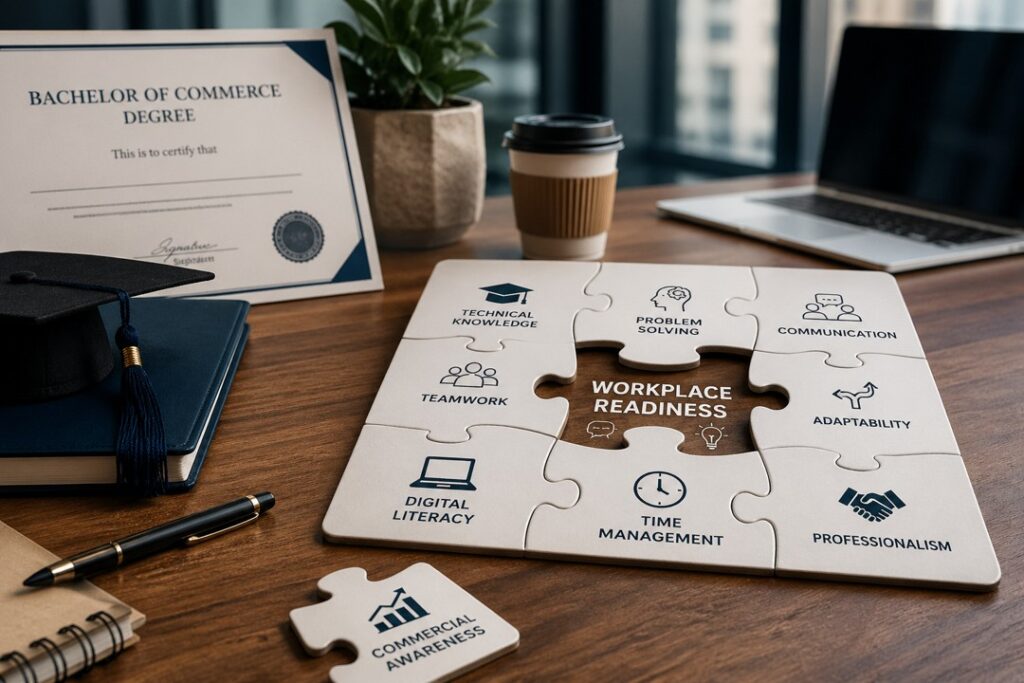
Many graduates leave university with knowledge, ambition and potential. But employers often need something more immediate, such as communication, problem-solving, commercial awareness, digital confidence, resilience and the ability to contribute in a real workplace.
That is the skills gap reality.
The issue is not that graduates lack value. It is that the transition from academic learning to workplace performance is often insufficiently structured. Graduate programmes, internships and learnerships should do more than provide exposure. They should build measurable capability.
Our latest article explores what graduates know, what employers actually need, and how organisations can design better pathways for the development of young talent.
Executive Overview
South Africa does not have a shortage of educated young people. It has a shortage of workplace-ready young professionals who can move confidently from academic knowledge into practical contribution. This distinction matters. Many graduates leave universities and colleges with qualifications, theoretical understanding and ambition, yet employers often need something more immediate: problem-solving, communication, accountability, digital fluency, commercial awareness, resilience and the ability to operate in teams.
The result is a difficult paradox. Graduates struggle to get their first opportunity because they lack experience, while employers struggle to find entry-level talent that can become productive quickly. Statistics South Africa reported that among 4.8 million unemployed youth in the first quarter of 2025, 58.7% had no previous work experience, highlighting the persistent barrier between education and employment.
For organisations, the answer is not simply to complain that graduates are not ready. The answer is to build structured bridges between potential and performance. Graduate programmes, internships, learnerships and young professional development initiatives must become more deliberate, more practical and more closely aligned with real business needs.
The gap is not only academic
The skills gap is often misunderstood as a failure of education alone. That is too simplistic. Universities and colleges play a vital role in developing knowledge, discipline and technical foundations. However, the workplace is changing faster than many formal curricula can adapt.
Employers are no longer only asking whether a graduate understands a subject. They are asking whether that graduate can apply knowledge under pressure, work with others, use digital tools, interpret information, solve unfamiliar problems and communicate clearly with colleagues, clients and managers.
The Department of Higher Education and Training’s 2024 National List of Occupations in High Demand notes that South Africa has high levels of education-to-job mismatch, with 51.7% of workers employed in occupations for which they do not have the correct education level. It also reports that 30.3% of workers are employed in occupations that do not match their field of study.
This tells us something important: qualification does not automatically equal fit. A degree or diploma may open the door, but it does not always provide the full set of behaviours, habits and practical capabilities required to perform effectively inside an organisation.
What graduates often know
Many graduates enter the workplace with valuable strengths. They understand theory. They can research, study, write assignments, absorb information and pass assessments. Many are digitally comfortable, ambitious and eager to progress. They often bring fresh thinking, diversity of perspective and energy into organisations that need renewal.
However, academic success is usually measured differently from workplace success. In education, the individual is often assessed on what they know. In the workplace, the individual is assessed on what they can contribute.
A graduate may know the principles of project management but struggle to manage competing priorities. They may understand financial concepts but not yet understand how commercial decisions are made in a live business environment. They may be comfortable with technology but not yet know how to use data to make a recommendation. They may write well academically but struggle to prepare a concise business update for a manager.
write well academically but struggle to prepare a concise business update for a manager.
This is not a criticism of graduates. It is a reality of transition. The move from classroom to workplace requires a different kind of learning.
What employers actually need
Employers need graduates who can become useful, adaptable and dependable quickly. Technical knowledge still matters, but it is no longer enough. The World Economic Forum’s Future of Jobs Report 2025 identifies analytical thinking as the top core skill for employers, with seven out of ten companies considering it essential. It also highlights resilience, flexibility, agility, leadership, social influence, creative thinking, motivation and self-awareness among the most important capabilities.
This aligns strongly with what South African graduate employers are experiencing. The South African Graduate Employers Association reported that employers receive more than 100 applications per vacancy, yet many still report a shortage of candidates with the right skill sets. Employers increasingly need technically literate graduates, but they also emphasise resilience, communication and a desire for continued learning.
In practical terms, employers need young talent who can:
- Understand how the business creates value
- Communicate clearly and professionally
- Use information to solve problems
- Work with people across different functions
- Manage deadlines and expectations
- Learn quickly from feedback
- Show ownership without constant supervision
- Adapt when priorities change
- Use digital tools responsibly and productively
- Demonstrate resilience when work is difficult
These are not always taught explicitly in formal education, but they are essential to employability.
The hidden cost of poor workplace readiness
When graduates are not properly prepared for the workplace, the cost is felt by both sides.
Graduates experience frustration, rejection and loss of confidence. Employers experience slow onboarding, increased supervision demands, uneven performance and higher turnover. Managers become reluctant to invest time in young talent because previous experiences have been disappointing. This creates a damaging cycle: fewer opportunities are offered, fewer graduates gain experience, and the skills gap widens.
There is also a strategic cost. Organisations that fail to build young talent pipelines become overdependent on experienced hires. This is expensive, competitive and often unsustainable. If every company is chasing the same limited pool of experienced talent, the market becomes more costly without necessarily becoming more capable.
A structured graduate programme can break this cycle. It gives employers a disciplined way to identify potential, develop capability and create a stronger internal talent pipeline.
Why graduate programmes must be redesigned
Traditional graduate programmes often focus too heavily on exposure and too lightly on measurable capability. Graduates rotate through departments, attend workshops and complete assignments, but the programme may not be sufficiently connected to the organisation’s real skills requirements.
A stronger approach begins with one question: what must a graduate be able to do after 3, 6, 12 and 24 months?
This shifts the programme from activity to outcome. It allows employers to define the specific capabilities required for success, such as client communication, report writing, data interpretation, stakeholder engagement, commercial thinking, professional conduct and problem-solving.
The Organisation for Economic Co-operation and Development describes a skills-first approach as one that prioritises validated skills over credentials, helping employers broaden talent pools and improve job matching. It also cautions that this shift requires reliable skills intelligence, quality training systems and stronger human resource management capability.
For South African employers, this is highly relevant. Graduate programmes should not be treated as administrative exercises. They should be designed as capability-building systems.
What an effective graduate development model should include
An effective graduate programme should combine structure, practical learning and accountability.
It should include:
- Clear role-based competency frameworks
Graduates need to know what good performance looks like. Employers need to define the technical, behavioural and professional competencies required for each role family. - Practical business assignments
Graduates should work on real problems, not artificial exercises only. This builds confidence, judgement and relevance. - Structured workplace coaching
Managers should not be left to “figure it out”. They need guidance on how to coach, review progress and give constructive feedback. - Professional communication training
Many graduates need support in writing emails, preparing updates, presenting ideas and managing workplace conversations. - Commercial and organisational awareness
Graduates must understand how the organisation makes money, manages risk, serves customers and measures success. - Digital and data confidence
Digital literacy should go beyond basic tool usage. Graduates need to interpret data, use systems, understand workflows and apply technology to improve productivity. - Resilience and adaptability development
The workplace requires emotional maturity, persistence and the ability to respond constructively to feedback and setbacks. - Assessment and feedback loops
Programme success should be measured. Employers should assess progress, identify gaps early and adapt development interventions accordingly.
Why employers must participate more actively
Employability cannot be outsourced entirely to universities, colleges or training providers. Employers have to be active participants in shaping the capabilities they require.
This means providing clearer signals about workplace expectations. It means offering internships, learnerships and graduate programmes that expose young people to real work. It also means aligning internal stakeholders before graduates arrive, so that the programme is not seen as an obligation but as a strategic talent investment.
The most effective organisations treat graduate development as part of workforce planning. They identify future capability gaps, map entry-level roles to growth pathways, and build young talent deliberately rather than reactively.
This is especially important in South Africa, where youth unemployment, transformation priorities and critical skills shortages intersect. Graduate programmes are not just talent initiatives. They are economic participation mechanisms, employer brand assets and long-term capability investments.
The role of Duja Consulting
Duja Consulting supports organisations with structured talent solutions, including learnerships, internships and graduate programmes. The value lies in helping employers move beyond informal intake processes towards managed, measurable and practical development pathways.
A well-designed graduate programme can help an organisation:
- Build a stronger young talent pipeline
- Improve workplace readiness
- Support skills development objectives
- Reduce dependence on scarce experienced hires
- Strengthen transformation and inclusion outcomes
- Improve retention through clearer development pathways
- Equip managers to support young professionals effectively
- Align graduate development with real business priorities
When graduate programmes are designed properly, employers stop asking why graduates are not ready and start building the conditions that make readiness possible.
Conclusion
The skills gap reality is not that graduates know nothing. It is that many graduates know different things from what employers urgently need. They may have academic knowledge, but employers need applied capability. They may have potential, but employers need performance. They may have ambition, but employers need workplace discipline, problem-solving and adaptability.
Closing this gap requires more than recruitment. It requires intentional programme design, structured development, practical exposure, manager involvement and clear measurement.
South Africa’s graduate employability challenge will not be solved by education providers alone, nor by employers simply raising entry-level expectations. It will be solved through better bridges between learning and work.




Duja Consulting helps organisations design and manage graduate, internship and learnership programmes that turn young potential into practical workplace capability. To strengthen your graduate talent pipeline and build skills that match real business needs, connect with Duja Consulting.