Why Outsourced Forensic Teams Often Deliver Faster Case Resolution
Why Outsourced Forensic Teams Often Deliver Faster Case Resolution
When a forensic matter emerges, time becomes a risk factor. Evidence can disappear. Internal pressure can build. Stakeholders want answers. Yet internal teams are often already stretched, and sensitive matters may require independence as much as technical skill.
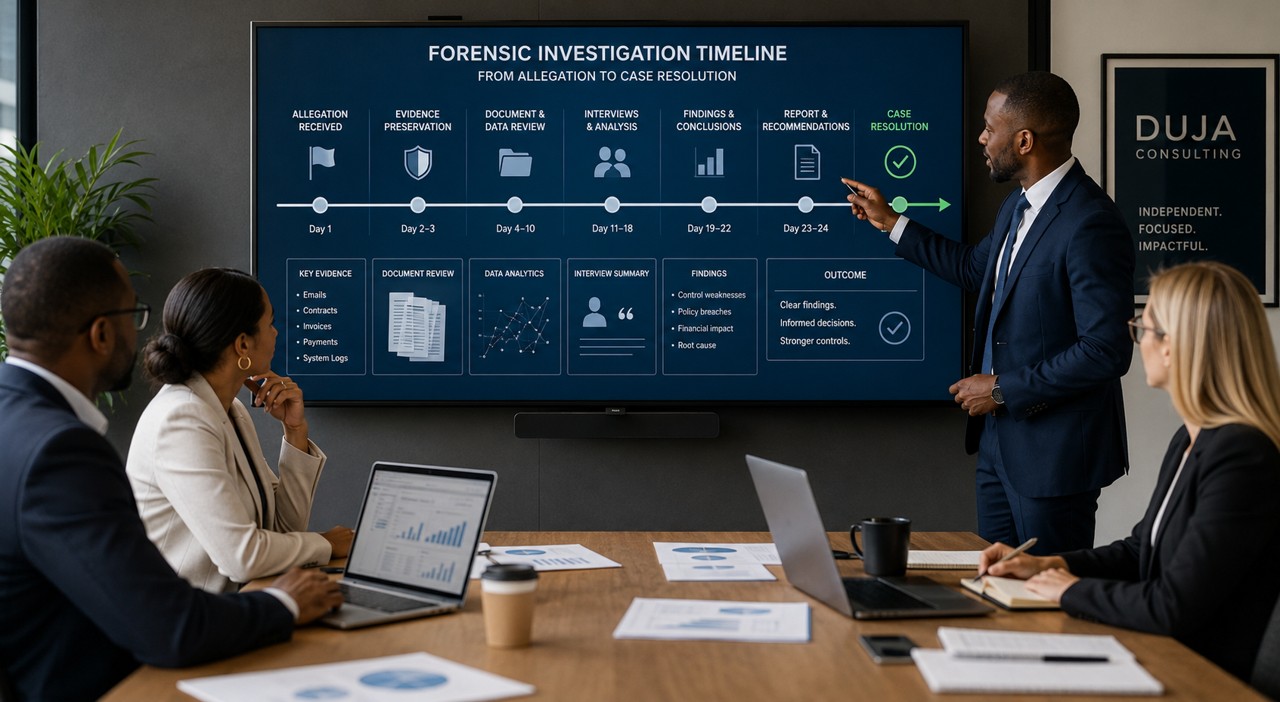
That is why outsourced forensic teams often help organisations resolve cases faster. The advantage is not simply “more people”. It is the ability to mobilise specialist skills quickly, preserve evidence properly, apply a structured investigation methodology and produce findings that boards, executives and audit committees can act on.
Forensic investigations should never be rushed. But they should be disciplined, focused and timely.
In our latest article, we explore why outsourced forensic teams often deliver faster case resolution — and why speed must always be balanced with independence, evidence integrity and defensible reporting.
When allegations of fraud, misconduct, procurement irregularities or governance failures arise, speed matters.
Delays can allow evidence to disappear, increase operational disruption, damage stakeholder confidence and make disciplinary or legal processes harder to sustain.
This is why many organisations are turning to outsourced forensic teams and forensic investigation services in South Africa to accelerate case resolution without compromising independence or evidentiary rigour.
Faster resolution is not about rushing to conclusions.
It is about mobilising the right expertise quickly, applying a structured investigation methodology, protecting evidence from the outset and giving decision-makers defensible findings they can act on.
The challenge with internal investigations
Many organisations have capable risk, audit, compliance and legal teams.
However, when a forensic matter emerges, those internal teams are often already under pressure from their day-to-day responsibilities.
A serious case can require immediate interviews, document preservation, digital evidence review, procurement analysis, financial reconstruction and stakeholder reporting.
Internal teams may also face constraints that slow progress.
They may not have specialist forensic tools. They may lack sufficient capacity. They may be too close to the people, departments or processes under review.
In sensitive matters, perceived independence can be as important as technical competence.
These factors do not mean internal teams are ineffective.
They mean that forensic cases often require a different operating model: one designed for speed, independence and disciplined evidence management from day one.
1. Outsourced forensic teams can mobilise quickly
One of the main reasons outsourced forensic teams often resolve cases faster is that they are built to mobilise around urgent matters. Instead of assembling an internal project team from already stretched departments, an outsourced provider can deploy investigators, analysts and subject-matter specialists according to the case requirements.
This is particularly valuable when the initial facts are unclear. A suspected payroll irregularity, procurement concern or whistle-blower report may require rapid scoping before the organisation knows the full scale of the issue. An experienced forensic team can help define the investigation plan, identify evidence sources, prioritise immediate actions and prevent the matter from drifting.
Speed at the start of an investigation often determines the quality of the outcome. The earlier evidence is secured and the investigation pathway is clarified, the lower the risk of delay later.
2. Specialist skills reduce the learning curve
Forensic investigations are not the same as ordinary internal reviews. They require knowledge of evidence handling, interviewing, fraud typologies, financial analysis, digital records, procurement processes, employment procedures and governance standards.
Outsourced forensic teams bring these capabilities together. They have often dealt with similar matters across multiple industries and organisational environments, which means they do not have to learn the basics of forensic case management while the investigation is already underway.
This experience helps them recognise patterns faster. They know which documents to request, which data fields matter, which control failures are relevant and which early warning signs may indicate a broader issue. That reduces false starts and helps the investigation move from allegation to evidence-based findings more efficiently.
3. Independence helps remove internal friction
Forensic cases can become politically sensitive. Employees may be reluctant to share information. Managers may worry about reputational consequences. Internal investigators may be perceived as conflicted, especially if the matter involves senior individuals, procurement decisions, finance teams or operational leadership.
An outsourced forensic team can bring a more independent lens. This independence helps build confidence among boards, audit committees, executives, regulators, employees and external stakeholders. It can also reduce internal debate about whether the investigation is objective.
When stakeholders trust the process, the case can move faster. Less time is spent questioning the credibility of the investigation and more time is spent addressing the facts
4. Dedicated capacity prevents cases from stalling
A common cause of slow case resolution is not complexity, but competing priorities. Internal teams may begin an investigation with urgency, only for progress to slow when month-end, audits, board packs, operational issues or other business demands intervene.
Outsourced forensic teams are engaged specifically to progress the matter. Their time, resources and reporting cadence are aligned to the investigation plan. This dedicated capacity is one of the clearest practical advantages of forensic outsourcing.
For executive teams, this matters because unresolved cases can become a drag on the organisation. They consume management attention, affect employee trust and create uncertainty around disciplinary, civil, criminal or governance actions. A dedicated forensic team helps maintain momentum until the matter reaches a clear conclusion.
5. Structured methodology improves efficiency
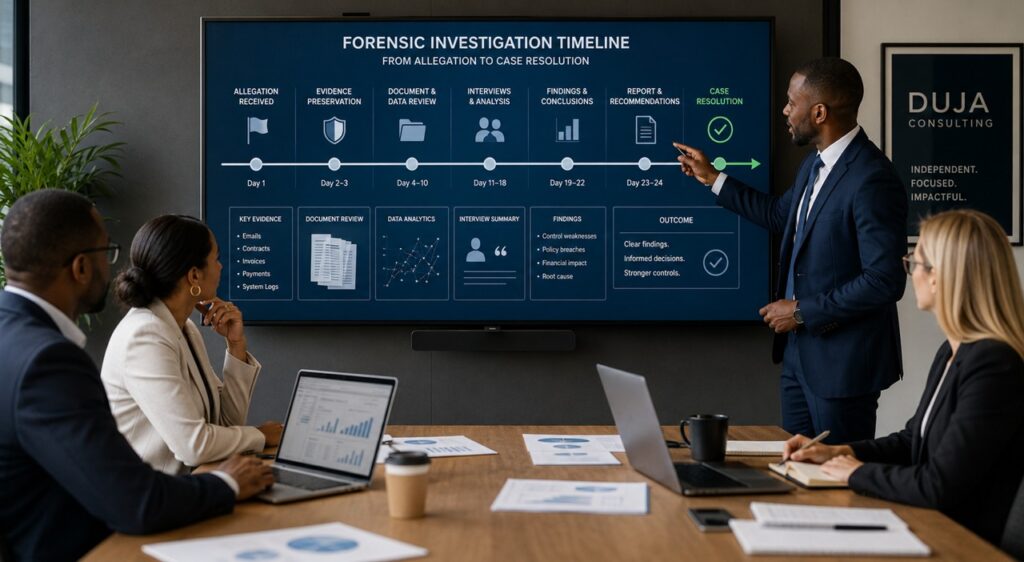
Fast investigations are rarely improvised. They follow a disciplined methodology. This typically includes intake and scoping, evidence preservation, document and data review, interviews, analysis, findings, reporting and recommended next steps.
An outsourced forensic provider should bring established templates, investigation protocols, reporting formats and quality review processes. This structure reduces rework. It also helps ensure that each phase of the investigation is properly documented and aligned to the eventual use of the findings.
A well-run investigation is not only faster; it is more defensible. This is important where findings may inform disciplinary processes, recovery action, control remediation, supplier decisions or referrals to law enforcement.
6. Better evidence handling reduces delays later
Evidence is the foundation of any forensic matter. If evidence is poorly preserved, inconsistently documented or collected without a clear chain of custody, the investigation may face delays when findings are challenged.
Outsourced forensic teams understand the importance of evidence discipline. They can help organisations identify relevant documents, emails, transaction records, access logs, supplier files, contracts, approvals and other data sources. They can also support the preservation of digital and physical evidence before it is altered, deleted or contaminated.
This discipline often saves time later. A case that is built on properly handled evidence is less likely to require repeated evidence collection, additional interviews or corrective work before management can act.
7. Technology and analytics can accelerate fact-finding
Modern forensic work increasingly depends on data. Procurement activity, payroll records, expense claims, supplier master files, payments, email trails and system logs can reveal patterns that are difficult to detect manually.
Outsourced forensic teams often have access to analytical tools and repeatable testing approaches. These can help identify duplicate payments, unusual supplier relationships, split orders, approval anomalies, conflicts of interest, irregular payroll changes or suspicious transaction patterns.
Analytics does not replace professional judgement, but it can accelerate the process of narrowing the field. Instead of reviewing everything manually, investigators can focus on the transactions, people, suppliers or processes that present the highest risk.
A forensic investigation is only useful if its findings can be understood and acted on. Executives, boards and audit committees need reports that distinguish between allegation, evidence, finding, impact and recommendation.
Outsourced forensic teams are accustomed to producing reports for decision-making. Their outputs can help management decide whether to take disciplinary steps, strengthen controls, recover losses, engage legal counsel, refer a matter externally or close a case where allegations are not substantiated.
This clarity can materially shorten the time between investigation and action. Without it, organisations may complete the fact-finding process but still spend weeks debating what the findings mean.
Faster does not mean less rigorous
The value of outsourced forensic teams lies in disciplined acceleration.
The goal is not to produce quick answers at the expense of fairness, evidence or due process. The goal is to prevent avoidable delays while ensuring the investigation remains objective, structured and defensible.
This distinction matters. Poorly handled investigations can damage reputations, undermine employee trust and create legal risk.
A credible forensic process must balance urgency with care.
When should an organisation consider outsourcing forensic work?
Outsourcing is especially useful when:
The matter involves senior employees, executives, suppliers or politically sensitive relationships
Internal teams lack capacity or specialist forensic experience
Evidence may be at risk of being altered, deleted or withheld
The organisation needs independent assurance for a board, audit committee or external stakeholder
The case involves procurement, payroll, finance, governance or control failures
Findings may support disciplinary, civil, criminal or regulatory action
The organisation needs rapid scoping after a whistle-blower report or red flag
In these situations, an outsourced forensic team can provide both technical capability and process credibility.
The Duja Consulting perspective
Duja Consulting’s Audit & Forensic Practice supports organisations with forensic investigations, probity audits and governance-focused reviews. For South African organisations facing suspected fraud, irregular expenditure, misconduct or control breakdowns, the benefit of an outsourced forensic team is not only independence. It is the ability to bring the right skills, structure and focus to a matter when time is critical.
A faster case resolution can help an organisation contain risk, restore confidence and move from uncertainty to informed action.
Connect with Duja Consulting!Follow us on LinkedIn!
If your organisation needs independent support with a sensitive matter, suspected fraud, procurement concern or governance review, Duja Consulting can help. Contact Duja Consulting to discuss how an outsourced forensic team can support a faster, more defensible case resolution.
Dominate Recruitment in Your Industry with aDynamic Virtual Recruitment Platform
Our solution focuses on reducing the need for face to face screening interviews, whilst allowing you to gain more dynamic insight into potential candidates at the outset of the recruitment process.
At Play Interactive Talent delivers a consistent interview experience.
Our solution is completely automated and therefore we can guarantee a very consistent interview experience for all first screening interviews with candidates, as there is no risk of resources altering the competency interview process.
MASTER CLEANSE BESPOKE
IPhone tilde pour-over, sustainable cred roof party occupy master cleanse. Godard vegan heirloom sartorial flannel raw denim +1. Sriracha umami meditation, listicle chambray fanny pack blog organic Blue Bottle.
MASTER CLEANSE BESPOKE
IPhone tilde pour-over, sustainable cred roof party occupy master cleanse. Godard vegan heirloom sartorial flannel raw denim +1. Sriracha umami meditation, listicle chambray fanny pack blog organic Blue Bottle.
MASTER CLEANSE BESPOKE
IPhone tilde pour-over, sustainable cred roof party occupy master cleanse. Godard vegan heirloom sartorial flannel raw denim +1. Sriracha umami meditation, listicle chambray fanny pack blog organic Blue Bottle.
MASTER CLEANSE BESPOKE
IPhone tilde pour-over, sustainable cred roof party occupy master cleanse. Godard vegan heirloom sartorial flannel raw denim +1. Sriracha umami meditation, listicle chambray fanny pack blog organic Blue Bottle.
MASTER CLEANSE BESPOKE
IPhone tilde pour-over, sustainable cred roof party occupy master cleanse. Godard vegan heirloom sartorial flannel raw denim +1. Sriracha umami meditation, listicle chambray fanny pack blog organic Blue Bottle.
MASTER CLEANSE BESPOKE
IPhone tilde pour-over, sustainable cred roof party occupy master cleanse. Godard vegan heirloom sartorial flannel raw denim +1. Sriracha umami meditation, listicle chambray fanny pack blog organic Blue Bottle.
MASTER CLEANSE BESPOKE
IPhone tilde pour-over, sustainable cred roof party occupy master cleanse. Godard vegan heirloom sartorial flannel raw denim +1. Sriracha umami meditation, listicle chambray fanny pack blog organic Blue Bottle.
MASTER CLEANSE BESPOKE
IPhone tilde pour-over, sustainable cred roof party occupy master cleanse. Godard vegan heirloom sartorial flannel raw denim +1. Sriracha umami meditation, listicle chambray fanny pack blog organic Blue Bottle.
ORGANIC BLUE BOTTLE
Godard vegan heirloom sartorial flannel raw denim +1 umami gluten-free hella vinyl. Viral seitan chillwave, before they sold out wayfarers selvage skateboard Pinterest messenger bag.
TWEE DIY KALE
Twee DIY kale chips, dreamcatcher scenester mustache leggings trust fund Pinterest pickled. Williamsburg street art Odd Future jean shorts cold-pressed banh mi DIY distillery Williamsburg.