
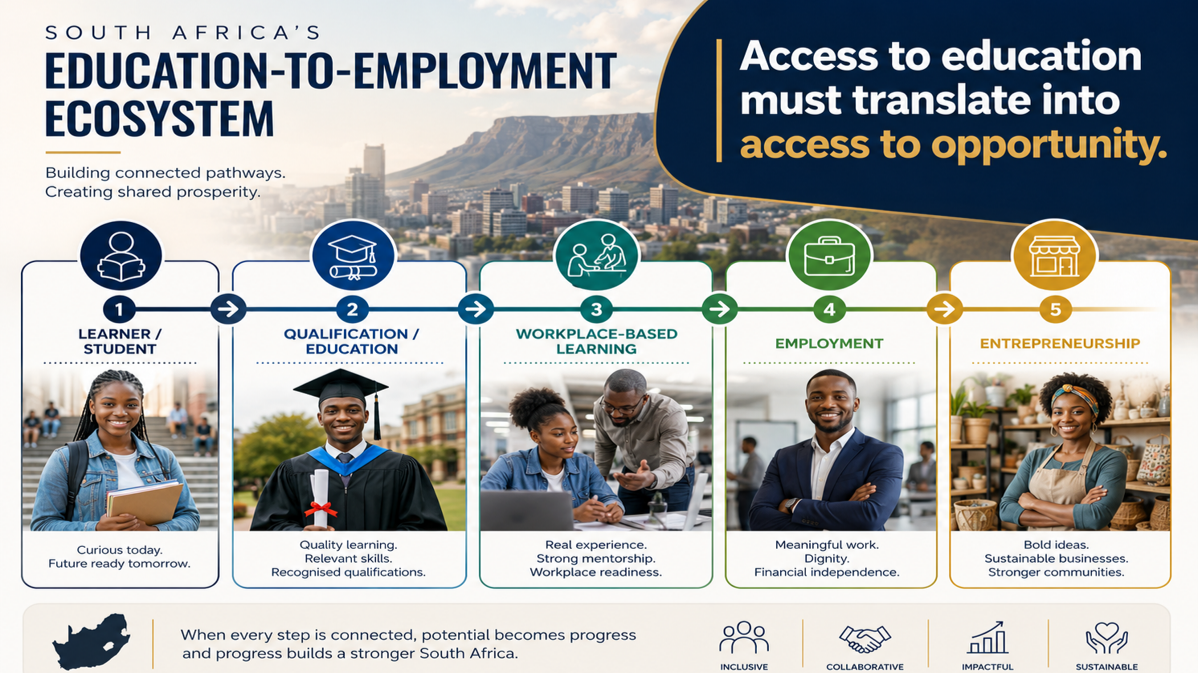
A More Mature Compact for South Africa's Education-to-Employment Ecosystem
A more mature compact for South Africa’s education-to-employment ecosystem.
The recent engagement between Deputy Minister Dr Mimmy Gondwe and South Africa’s private higher education sector should be viewed as more than a higher education discussion.
It is a national skills, employability and economic participation discussion.
South Africa’s Post-School Education and Training system includes public universities, TVET colleges, community education institutions, private providers, occupational training providers, SETAs, employers and workplace learning partners.
Each has a role to play.
Public institutions bring scale, research depth and transformation leadership.
Private providers often bring agility, innovation and responsiveness to labour market needs.
Employers provide the workplace environments where learning becomes competence.
The question is no longer whether private higher education has a role to play.
The question is how all parts of the system can collaborate more effectively to improve access, quality, employability and economic participation.
Access to education alone cannot be the measure of success.
South Africa needs stronger pathways that connect qualifications to meaningful workplace exposure, internships, learnerships, apprenticeships, work-integrated learning and sustainable employment.
Workplace-based learning should not be treated merely as a compliance requirement or funding mechanism.
It is one of the most important transition mechanisms in the education-to-employment journey.
At Duja Consulting, we believe the opportunity is to build a more integrated talent development ecosystem where public and private institutions, employers, SETAs, government and implementation partners work together around measurable outcomes.
The real test will not be the number of meetings held.
The real test will be whether more young South Africans gain quality education, relevant skills, meaningful workplace experience and access to sustainable economic participation.
That is the outcome that matters.
To explore workplace-based learning, graduate placement, learnership, internship or youth employability partnerships, contact Duja Consulting at info@duja.co.za or visit www.duja.co.za
This article was inspired by recent engagements announced by the Department of Higher Education and Training (DHET) and reported by SANews and Skills Portal on 6 June 2026 under the title, “Deputy Minister Dr Mimmy Gondwe to Engage Private Higher Education Institutions in Nationwide Collaboration Drive”.
The recent engagement between Deputy Minister Dr Mimmy Gondwe and South Africa’s private higher education sector may prove to be more significant than many initially realise.
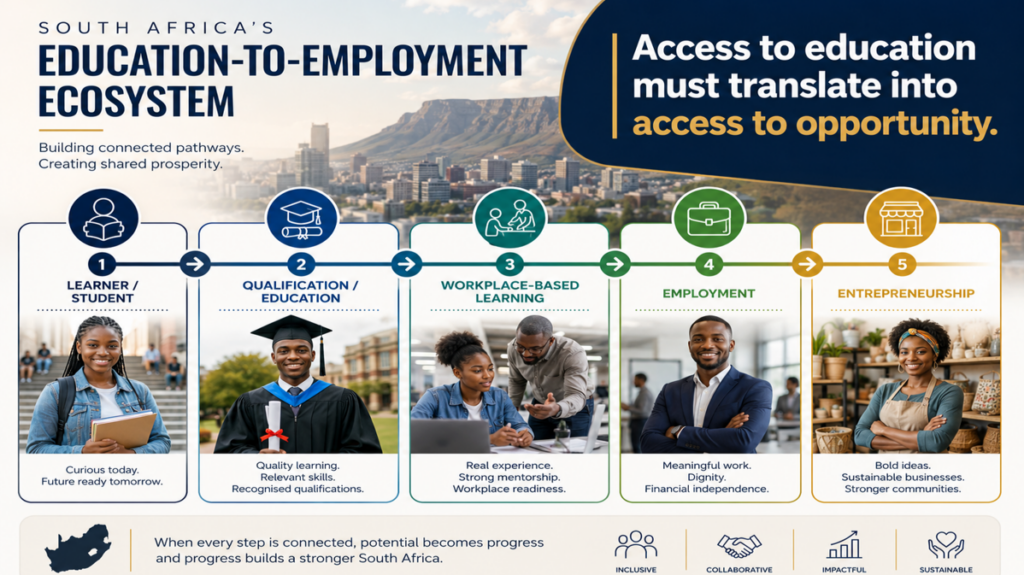
At its core, the discussion is not simply about higher education, it is about building a more connected and responsive education-to-employment ecosystem capable of supporting South Africa’s economic growth, competitiveness, and social development objectives.
South Africa’s Post-School Education and Training (PSET) system comprises a diverse network of universities, TVET colleges, community education institutions, occupational training providers, employers, SETAs, quality councils, and workplace learning partners. Each contributes a distinct role in developing the skills required by a modern economy:
- Public institutions contribute scale, research capacity, transformation leadership, and a longstanding commitment to broadening educational access.
- Private providers frequently bring agility, innovation, and responsiveness to changing labour market requirements.
Employers provide the workplace environments where knowledge is converted into practical competence and productive capability.
The conversation is therefore no longer about whether private higher education has a role to play, that question has largely been settled. Attention is increasingly shifting towards how all stakeholders within the PSET system can collaborate more effectively to improve access, quality, employability, and economic participation.
The numbers tell an important story.
According to the latest Department of Higher Education and Training statistics, South Africa recorded approximately 1.36 million higher education enrolments in 2023. More than 286,000 of these students were enrolled at registered private higher education institutions, representing approximately 21% of total higher education enrolments.
During the same period, private institutions produced more than 60,000 graduates. These figures reflect the growing contribution of private higher education to South Africa’s skills development landscape. The sector has become an important contributor to expanding access, developing scarce and critical skills, and preparing graduates for participation in the economy.
Access to education alone cannot be the measure of success.
South Africa continues to face significant labour market challenges. Statistics South Africa’s Quarterly Labour Force Survey (Q1 2026) reported an official unemployment rate of 32.7%, with youth unemployment among people aged 15–34 remaining above 45%.
Graduate employment outcomes remain considerably stronger than those of individuals without post-school qualifications. Nevertheless, graduate unemployment remains a concern at approximately 12.2%.
The challenge extends beyond qualification attainment.
Many graduates, TVET completers and occupational qualification learners continue to encounter barriers when attempting to enter the labour market. Employers frequently seek candidates with workplace experience, yet access to meaningful workplace exposure remains one of the greatest obstacles facing first-time work seekers.
The contradiction is difficult to ignore – South Africa continues to report shortages in critical and scarce skills across multiple sectors. At the same time, thousands of graduates struggle to secure opportunities to demonstrate their capabilities in real workplace environments. The challenge is therefore not simply one of skills supply, it is a challenge of skills utilisation, labour market access and the effectiveness of the pathways that connect learning to employment. This is where the national conversation becomes particularly important.
Work-integrated learning, internships, apprenticeships, learnerships and workplace-based learning programmes should not be viewed merely as compliance requirements or funding mechanisms. These WBL programmes are critical transition mechanisms that enable learners to convert theoretical knowledge into workplace competence and employment readiness, the building blocks are:
- Greater collaboration between government, educational institutions, employers, and experienced implementation partners will be essential if South Africa is to improve graduate absorption at scale.
- Creating meaningful workplace opportunities requires more than good intentions. Recruitment, placement, employer engagement, learner support, monitoring, mentoring, quality assurance, and impact measurement all play a role in successful outcomes.
- Assign organisations with proven capabilities in these areas to help bridge the gap between education and employment, particularly for TVET graduates, unemployed youth and individuals pursuing occupations identified as critical to economic growth.
The opportunity before the PSET system is therefore not simply to produce more graduates. The opportunity is to build a more integrated talent development ecosystem that enables graduates to gain relevant workplace experience, demonstrate their capabilities and transition successfully into productive employment, entrepreneurship, and lifelong learning.
Access to education without employability cannot be considered success. For this reason, the recent engagement between government and private higher education institutions should not be viewed solely through a regulatory lens. The engagement should be viewed through the broader lens of economic development, workforce readiness, and national competitiveness.
The future of South Africa’s skills development system does not lie in competition between institutions or sectors. Sustainable success will depend on collaboration that includes:
- Stronger alignment between qualifications and labour market demand.
- Expanded work-integrated learning and industry placements.
- Increased employer participation in workplace-based learning programmes.
- Greater recognition of micro-credentials and stackable qualifications.
- Increased use of Recognition of Prior Learning (RPL) pathways.
- Shared approaches to digital learning, learner support, and employability development.
- Joint efforts to improve graduate employment outcomes and entrepreneurship.
Collaboration, however, must be accompanied by accountability.
The opportunity presented by these engagements extends far beyond strengthening relationships between government and private providers, it is an opportunity to build a more mature compact for South Africa’s education-to-employment ecosystem where:
- Public and private institutions are viewed as complementary contributors to a shared national objective.
- Employers are recognised as essential partners in skills development rather than end-users of the system.
- Workplace-based learning becomes a central pillar of employability and economic participation.
- Success is measured not only by enrolment and graduation numbers, but by employment outcomes, entrepreneurship, and economic inclusion.
- Skills development is recognised as one of South Africa’s most important levers for inclusive growth and competitiveness.
The DHET’s ongoing efforts to combat illegal and unregistered institutions serve as an important reminder that quality assurance, accreditation and student protection remain non-negotiable. Public confidence in the PSET sector depends on maintaining rigorous standards and rigorous monitoring to validate that qualifications/certifications are credible, recognised and valued by employers.
The real test of these engagements will not be the number of meetings held or statements issued. The real test will be whether more young unemployed South Africans are able to access quality education, acquire relevant skills, gain meaningful workplace experience and transition successfully into sustainable employment.
That is the outcome that matters.
About Duja Consulting
The views expressed in this article reflect a commitment to strengthening South Africa’s education-to-employment ecosystem through collaboration, innovation, and evidence-based implementation.
Duja Consulting is a South African management consulting and implementation partner specialising in skills development, youth employability, workplace-based learning, project management, monitoring and evaluation (M&E). Since 2005, Duja has successfully supported thousands of unemployed youth, including university graduates, TVET graduates and first-time work seekers, to improve their employability and secure meaningful workplace experience, employment, and enterprise development opportunities. Working in partnership with government, SETAs, educational institutions, employers and development partners, Duja designs and implements scalable programmes that strengthen the connection between education, workplace learning and sustainable economic participation.
Contact Us
To explore opportunities for collaboration, workplace-based learning partnerships, graduate placement programmes, internships, learnerships, apprenticeships or youth employability initiatives, contact Duja Consulting at info@duja.co.za or visit www.duja.co.za.