
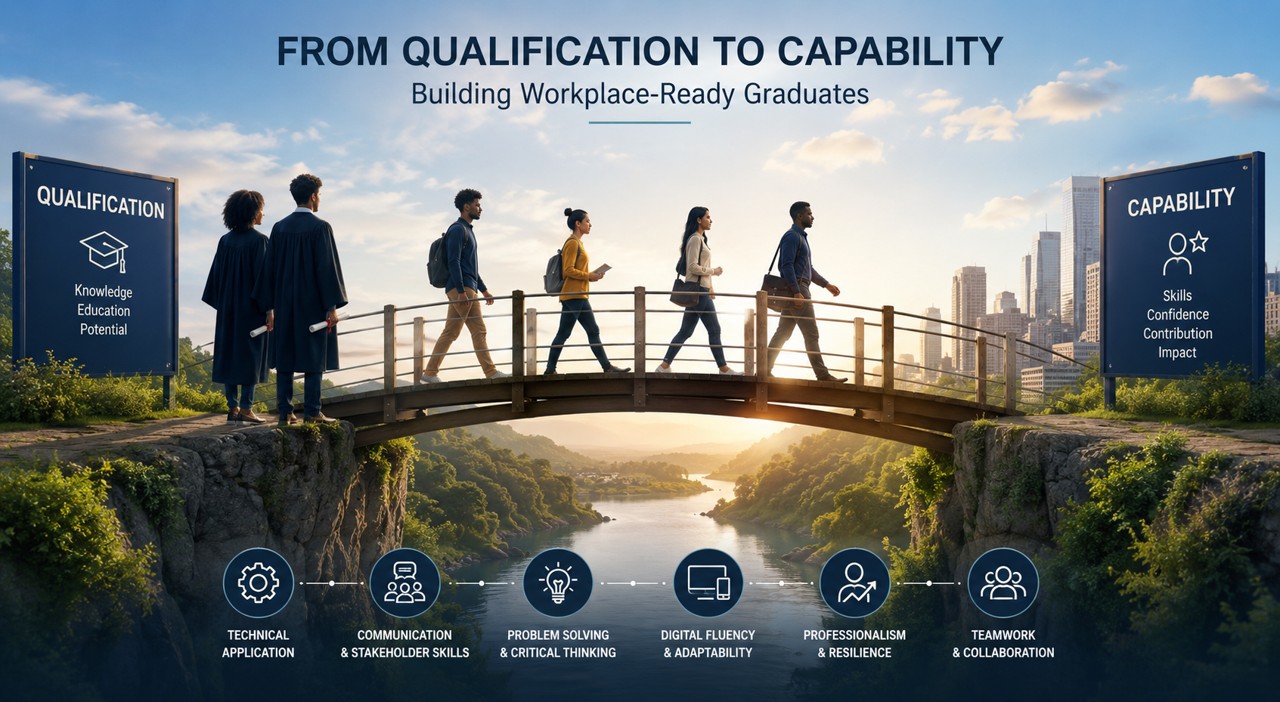
From Qualification to Capability: Redesigning Graduate Programmes for the Workplace
A qualification opens the door. Capability determines what happens next.
Many South African employers invest in graduate programmes, learnerships and internships, yet still find that young professionals need significant support before they can contribute confidently in the workplace.
The issue is not graduate potential. It is programme design.
Graduate programmes need to move beyond placement and completion metrics.
They should build the behaviours, judgement and applied skills that make graduates productive in real organisational environments.
That means stronger assessment, work-integrated learning, manager readiness, practical mentorship, structured feedback and clear measures of capability.
Our latest article explores how employers can redesign graduate programmes around workplace readiness , turning qualifications into contribution, confidence and long-term talent pipelines.
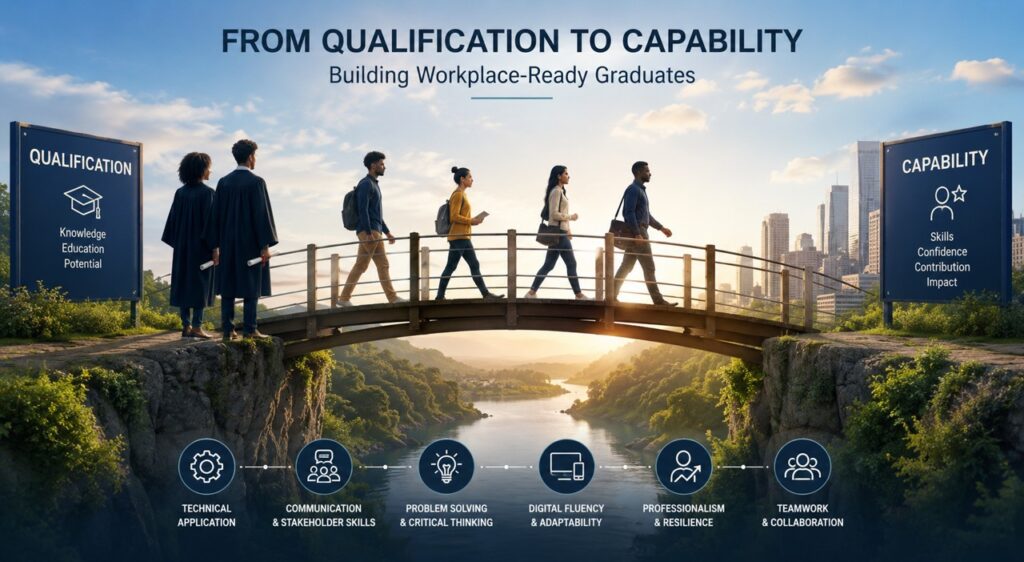
South African organisations invest heavily in graduate programmes, learnerships and internship pathways.
Yet many still experience the same frustration: promising graduates enter the workplace with qualifications, but not always with the capability to contribute confidently, professionally and productively from the outset.
This is not a criticism of graduates. It is a design challenge.
A qualification remains important. It signals commitment, technical exposure and potential.
But the modern workplace requires more than academic completion.
It requires judgement, communication, problem-solving, digital fluency, commercial awareness, resilience and the ability to apply knowledge in live organisational settings.
For employers, the question is no longer simply:
“How many graduates can we place?”
It is:
“How quickly can we help graduates become capable contributors?”
That shift — from qualification to capability — should shape the next generation of graduate programme management in South Africa.
Why Qualifications Alone Are No Longer Enough
South Africa’s graduate employment challenge sits inside a much broader labour-market problem.
Youth unemployment remains structurally high, while many employers continue to report difficulty finding candidates who are genuinely workplace-ready.
Even among graduates, the transition from education into work is not automatic.
The reason is clear. Education and work measure different things.
Academic environments reward individual performance, structured assignments, theoretical understanding and exam-based success.
Workplaces require collaboration, ambiguity, stakeholder management, time pressure, accountability and the ability to make progress without perfect information.
A graduate can therefore be highly qualified but still underprepared for the realities of the workplace.
They may know the theory but struggle to write a client-ready email.
They may understand a technical concept but hesitate in a project meeting.
They may have excellent marks but limited exposure to workplace etiquette, performance feedback, prioritisation or cross-functional collaboration.
This gap is not solved by orientation alone. It requires deliberate programme architecture.
The Capability Gap: What Employers Actually Need
A workplace-ready graduate is not simply someone who has completed a degree or diploma.
Capability is the ability to apply knowledge effectively in context.
For employers, this usually includes five dimensions:
1. Technical application
Graduates need opportunities to use their academic knowledge on real business problems.
This may include research, analysis, reporting, process mapping, customer support, data handling, compliance tasks or project administration.
The key is application.
A graduate programme should not be a passive placement. It should create structured opportunities for graduates to practise, receive feedback and improve.

2. Professional behaviour
Many performance concerns in graduate programmes are not about intelligence.
They are about professional habits.
These include punctuality, responsiveness, meeting preparation, personal presentation, accountability, confidentiality, workplace communication and the ability to accept feedback constructively.
These behaviours should be taught explicitly, not assumed.
3. Communication and stakeholder skills
Graduates often need help translating what they know into language that managers, colleagues and clients can use.
This includes writing concise updates, presenting recommendations, asking good questions, escalating issues appropriately and adapting tone for different audiences.
Strong communication is one of the fastest ways for a graduate to become trusted.
4. Problem-solving in ambiguity
The workplace rarely provides perfectly framed questions.
Graduates need to learn how to define problems, break them down, gather information, test options and make practical recommendations.
This is where business simulations, project-based learning and assessment centre methodologies can be powerful.
They expose graduates to realistic scenarios before the stakes are too high.
5. Confidence and resilience
Many young professionals enter organisations with limited confidence.
Others appear confident but struggle when they receive criticism or face unfamiliar expectations.
A strong graduate programme builds resilience through coaching, mentoring, peer learning and regular developmental feedback.
The objective is not to protect graduates from pressure.
It is to help them learn how to operate under it.
Redesigning Graduate Programmes Around Capability
A capability-led graduate programme differs from a traditional placement model.
It is more structured, more measurable and more closely linked to business outcomes.
Here are seven design shifts organisations should consider.
1. Start With the Work, Not the Qualification
Many programmes begin by identifying eligible graduates and placing them into departments.
A better starting point is to define the work the organisation needs graduates to perform.
What tasks can graduates realistically contribute to within three months, six months and twelve months?
Which business problems can they help solve?
What behaviours and skills will make them effective in those environments?
Once the work is clear, the programme can be designed backwards.
Recruitment, assessment, onboarding, learning content, mentorship and performance reviews can all be aligned to the capabilities required.
This approach also helps employers avoid over-reliance on academic filters.
Marks matter, but they do not tell the whole story.
Motivation, learning agility, communication, professionalism and problem-solving potential are often just as important.
2. Use Assessment to Identify Potential and Development Needs
Assessment should not only be used to select graduates. It should also be used to understand how to develop them.
Competency-based assessments, structured interviews, simulations, written exercises and group activities can reveal important insights.
For example, a candidate may show strong analytical ability but weak verbal confidence.
Another may communicate well but need help with structure and attention to detail.
When assessment data is carried into the programme design, development becomes more targeted.
Managers know what support is needed.
Graduates understand their growth areas.
Programme owners can group participants, assign mentors and design learning interventions more intelligently.
This is where professional assessment centre services can add significant value.
They make graduate selection and development more evidence-based, fair and defensible.
3. Replace Generic Training With Work-Integrated Learning
Many graduate programmes include classroom-based training, but the impact is limited if learning is not applied quickly.
Work-integrated learning connects training to real tasks.
For example:
- A session on business writing should be followed by drafting actual reports, emails or project updates.
- A module on problem-solving should be followed by a live business improvement challenge.
- A workshop on presentation skills should culminate in a presentation to managers.
- A lesson on customer service should be linked to real stakeholder interactions.
This approach turns learning into behaviour. It also gives managers a clearer view of progress.
Blended learning can be especially effective, combining digital modules, facilitated workshops, coaching, peer discussion and workplace assignments.
This allows graduates to learn at scale while still receiving practical support.
4. Build Manager Readiness Into the Programme
Graduate success does not depend only on the graduate.
It also depends on the manager.
Too often, graduates are placed into teams where line managers are busy, unclear about expectations or uncertain how to develop early-career talent.
The result is inconsistent experience.
Some graduates receive excellent guidance; others are left to “figure it out”.
A redesigned programme should prepare managers before graduates arrive.
Managers need clarity on:
- The purpose of the programme
- The graduate’s role and expected contribution
- The difference between supervision, coaching and mentoring
- How to give developmental feedback
- How to escalate concerns early
- How to create meaningful work without overwhelming the graduate
Manager enablement is one of the most overlooked success factors in graduate programme management.
5. Make Mentorship Practical, Not Symbolic
Mentorship is valuable only when it is structured.
A graduate who is assigned a mentor but never meets them gains little.
A mentor who is willing but unsure of their role may also struggle to add value.
Effective mentorship should include clear expectations, meeting frequency, discussion guides and feedback loops.
Mentors should help graduates understand workplace norms, career choices, organisational culture and professional judgement.
Mentorship should also complement, not replace, line management. The line manager focuses on performance and work delivery.
The mentor supports broader growth, confidence and navigation.
When done well, mentorship accelerates belonging and reduces the risk of early disengagement.
6. Measure Capability, Not Just Completion
Traditional programme metrics often focus on numbers: how many graduates were recruited, how many completed the programme, and how many were absorbed.
These metrics are important, but incomplete.
Capability-led programmes should also measure progress in areas such as:
- Time to productivity
- Quality of work outputs
- Attendance and reliability
- Manager satisfaction
- Professional behaviour
- Communication improvement
- Assessment score movement
- Retention after absorption
- Graduate confidence and engagement
- Contribution to business projects
This gives HR, L&D and business leaders a much clearer view of return on investment. It also helps identify where the programme should be improved.
7. Link Graduate Development to Workforce Strategy
Graduate programmes should not be treated as isolated HR initiatives.
They should be part of the organisation’s workforce strategy.
This means asking:
- Which skills will the business need over the next three to five years?
- Which roles are difficult or expensive to recruit externally?
- Where can young talent be developed into future specialists, supervisors or managers?
- How does the programme support transformation, succession and B-BBEE objectives?
- Which business units should host graduates because they offer strong learning environments?
- What future capability must the organisation build internally?
When graduate programmes are linked to workforce planning, they become strategic talent pipelines rather than compliance exercises.
The Role of Duja Consulting
Duja Consulting supports organisations in designing and managing structured talent development pathways, including learnerships, internships and graduate programmes.
This includes helping employers think beyond placement and completion towards capability, productivity and long-term value.
A well-designed graduate programme should give young professionals a fair opportunity to succeed while giving employers a stronger, more reliable talent pipeline.
That requires programme design, assessment, blended learning, mentorship structures, manager enablement and clear measurement.
In a labour market where both unemployment and skills shortages can exist at the same time, employers need practical bridges between education and work.
Graduate programmes can be one of those bridges — but only if they are designed for capability.
Conclusion: Capability Is the Real Outcome
The future of graduate programme management is not about replacing qualifications. It is about completing the journey that qualifications begin.
A qualification says a young person has learned. Capability shows they can contribute.
For South African employers, this distinction matters.
Graduate programmes that merely place young people into roles may meet short-term targets.
Graduate programmes that build capability create a stronger workforce, improve productivity, support transformation and help young professionals build meaningful careers.
The organisations that get this right will not only improve graduate outcomes.
They will build a more sustainable pipeline of future-ready talent.




Contact Duja Consulting
Duja Consulting helps organisations design and manage graduate programmes that build workplace capability, not just programme completion.
To strengthen your graduate, internship or learnership pipeline, speak to Duja Consulting about structured programme design, assessment, blended learning and implementation support.